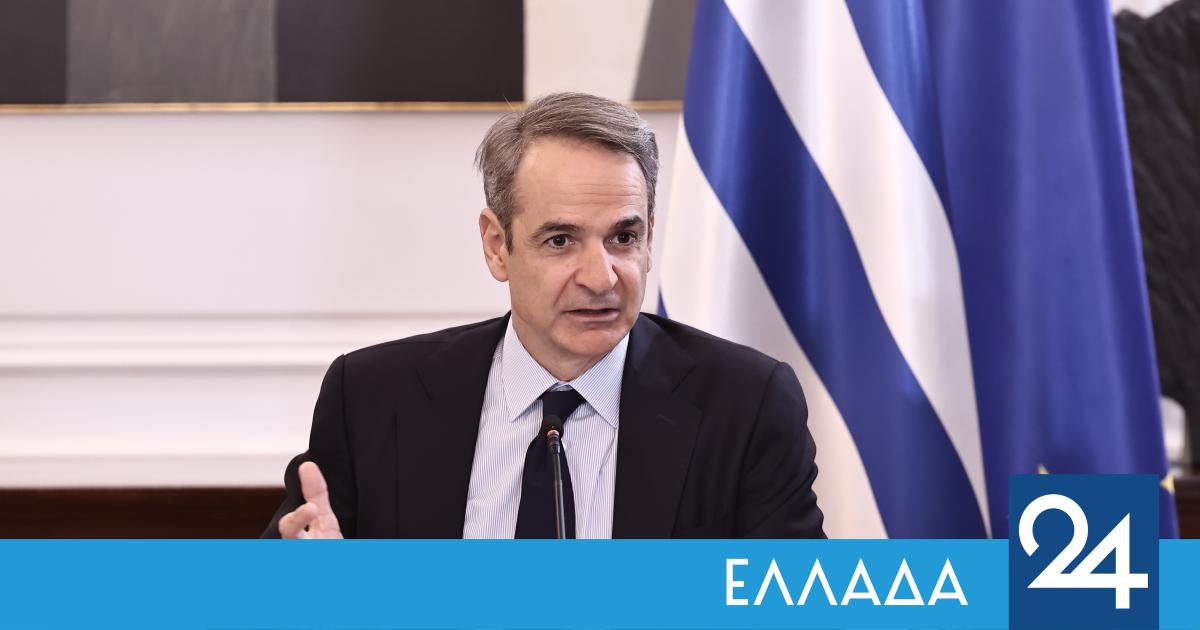
Kyriakos Mitsotakis in his Sunday post announced the extension of the diesel subsidy for June.
In the midst of an energy crisis due to the Middle East, the Prime Minister said in his post that developments are bringing the extension of the measure, while at the end of the month the extra 150 euros for each child will be added to families entitled to the extraordinary aid.
.
The Prime Minister also referred to hydrocarbon exploration, commenting that Chevron and HELLENiQ ENERGY have submitted a request for the US energy giant’s participation in the concession of Block 10, off the Cyparissia Gulf in the southern Ionian Sea.
“This consortium, I recall, has signed lease agreements with the Hellenic Republic for four new sea areas south of Crete and the Peloponnese. This development adds to a series of moves that confirm that Greece is now seen as a country with serious energy prospects,” he said.
Also, in his post he sent a message to students taking the Panhellenic exams, saying that the exams are an important goal “but not the only one” stressing that “no result can measure the value, potential or path of a young person”.
.
Finally, he made particular reference to the changes the Department of Labour is bringing in terms of equal pay regardless of gender.
The Prime Minister’s message
.
National Examination days and I want to start with a thought for candidates. I know that these days everything seems to be decided by one paper in a matter of hours. But that is not the case.
The Panhellenic exams are an important milestone, not the only one. So enter the hall with a clear mind, without loading up on more stress than you already have. No one result can measure a young person’s worth, potential or trajectory. And, certainly, life opens up more avenues than we can often see at this age. I wish you all the best of luck and may the efforts you have put in all this time be vindicated. As it is perfectly normal these days to feel more pressure or stress, the Ministry of Education has launched until 30 June the 1550 free telephone line for psychological support for candidates and their families, a nationwide network of psychologists from the Centres for Interdisciplinary Assessment, Counselling and Support. Don’t hesitate to use it if you feel you need it.
Go to the government project. I’ll start with accuracy, as ongoing developments in the Middle East are leading to a prolonged energy crisis and, by extension, affecting prices and people’s daily lives. That is why we have decided to extend the subsidy on diesel for June, with an increase of 15 cents per litre, so that the price remains about 30 cents lower than in March. At the end of the month, the exceptional aid of 150 euros per child will also be paid, without any application, with extended income criteria covering more than 80% of the country’s households, so that almost one million families will benefit from this measure. I am aware that these exceptional measures alone do not solve the problem of poverty that continues to weigh on many households. But they are at least a small breath of fresh air in a difficult situation.
I have referred several times recently to hydrocarbon exploration and the growing interest of major international energy groups in our country. I repeat myself because each new step has its own significance. This time, Chevron and HELLENiQ ENERGY have submitted a request for the participation of the American energy giant in the concession of Block 10, off the Kyparissia Gulf, in the Southern Ionian Sea. This consortium, I recall, has signed lease agreements with the Hellenic Republic for four new sea areas south of Crete and the Peloponnese. This development adds to a series of moves that confirm that Greece is now seen as a country with serious energy prospects. It does not, of course, prejudge any outcome. But it shows that international interest not only remains strong, but is expanding, gradually strengthening our country’s position on the energy map of the Eastern Mediterranean.
I come to the Recovery Fund, where we are now entering the final stretch for its completion. During the week our country submitted a double disbursement request, the 7th for the loan leg and the 8th for the reform and project leg, totalling €1.63 billion. To those who are wondering whether the reform part of the programme is progressing, the answer is yes: to date we have completed 86.15% of the reform milestones that, in a measurable way, digitise the state and the economy, drive the country’s energy transition, simplify the business environment, reduce bureaucracy, upgrade public health and education and speed up the administration of justice.
One of these reform milestones was the Land Registry, the complete mapping of the country’s real estate, a pending issue that has plagued the country for nearly two centuries. Its completion is now very close, with the posting of cadastral data covering 99% of the territory. This means that citizens can now, through the digital map maps.ktimatologio.gr, see their property data in aggregated form, check it and, where necessary, request corrections. This is a profound institutional reform that goes far beyond the limits of a simple administrative change. The Land Registry is a foundation for legal certainty, investment, the protection of citizens’ property and the overall development of the country. Our goal is to finally close this 200-year-old pending issue by the end of the year. And we will achieve it.
But the completion of the Recovery Fund does not mean the end of our flagship innovative policies.
.
One such example is the Prevent programme, which will continue in the coming years, as we have already secured €300 million in funding for 2027-2030 for free screening for breast, cervical and colorectal cancer, cardiovascular risk, adult and juvenile obesity and kidney dysfunction. Prevention has for decades been the ‘poor relation’ of the health system in our country. We have chosen to change this and the results are already visible. More than 317,000 of our fellow citizens detected a finding in time and were able to receive appropriate medical care. That’s why screening programmes are now becoming a firm part of our public health policy.
I am looking forward to the health sector, as the NHS has acquired yet another renovated Emergency Department, this time at the Piraeus Metaxas Cancer Hospital. For patients this means better conditions, shorter waits and better quality care at a particularly difficult time in their lives. New premises and modern medical equipment allow staff to manage emergencies more efficiently and provide better services. With the completion of the total refurbishment of Metaxas, thanks to Allwyn’s donation, we will be talking about a substantially new oncology hospital in three years’ time.
In labour, we are bringing forward a new bill that takes another step towards a fairer labour market, where the same job is paid the same regardless of gender. Although the principle of equal pay is already enshrined, in practice there are still wage inequalities, not only in Greece but across Europe. The incorporation of the relevant European Directive introduces for the first time a comprehensive framework of transparency in pay, both before recruitment and during the employment relationship and, if a pay gap is identified without an objective explanation, the employer will be obliged to take corrective action and reform the company’s pay structure, while the judicial protection of employees is also significantly strengthened. In general, however, speaking about the bill, it is worth noting that 65 proposals submitted by the National Social Partners, representatives of employees and employers have been incorporated into it so far.
I would also like to highlight another important provision of the bill: the inclusion of nurses, nursing assistants, paramedics and ambulance crews of the EHIC in the heavy and unhealthy category. A fair request from people who are on the front line of the NHS and emergency care every day.
A fair request from people who are on the front line of the NHS and emergency care every day.
In 2019, when we were first elected, I spoke to you about a more citizen-friendly state. A state that does not inconvenience them, that respects their time and puts an end to unnecessary bureaucracy. Seven years on, the steps we have taken in this direction are many. But that does not mean that we are stopping. Because a modern state is judged not only by major reforms, but also by whether it solves small problems that plague citizens on a daily basis. One of them was that the state often asked citizens to produce documents and certificates that were already in another public service. This is changing. From now on, these documents will be searched for in an official manner, without the citizen having to search for them and submit them over and over again. For example, it will no longer be necessary to produce again a marriage certificate, a copy of a degree, a copy of a diploma, an army diploma, a certificate of guarantor relatives, various cadastral certificates, etc. We also set clear deadlines for the administration.
When a citizen is waiting for a decision resulting in a financial benefit or compensation, the State should respond within three months. Of course, anyone who attempts to deceive the state with a false statement will face fines of up to €50,000 and the prescribed criminal consequences.
Before closing, I would like to mention two important interventions in the field of culture. Very important and particularly honourable is the news that in Malia, Crete, the Minoan Palace Centre now officially bears the UNESCO seal as a World Heritage Site, confirming the unique place of Minoan civilisation in the world’s cultural heritage. This recognition has not only symbolic value. The UNESCO seal is an important international distinction, but our real responsibility is to keep these sites alive and functional. That is why we are implementing EUR 3.5 million worth of projects to protect and upgrade the archaeological site, shielding it from the effects of the climate crisis. We are also doing the same in Rhodes, where work is proceeding apace on the restoration of the emblematic National Theatre, one of the island’s most important architectural landmarks. When the project is completed, the city will once again have a modern cultural space of international standards, worthy of its history and importance.
The main objective of the project is to restore the historic building of the National Theatre, which is one of the most important monuments of the Greek capital.
I conclude with a number that speaks volumes about our community and relates to sport. According to the annual report of e-Kouros for 2025, the digital system for recording the sports ecosystem that we established two years ago, 1 in 4 people in the country is directly or indirectly involved in amateur sport. The data also show that the number of male and female athletes has increased by 4.05% in one year, while 1 in 3 high school-aged children are registered in a sports club. This is a very optimistic picture that confirms the dynamics of sport in our country. e-Kouros now allows us to know precisely the needs of each sport and each region, so that we can design better policies, allocate resources more fairly and support clubs and infrastructure more effectively. The My Kouros App will soon follow, so that athletes, parents and fans can easily access useful information about the clubs, competitions and sports activities that interest them.
.
This concludes today’s review. Tomorrow we welcome the first month of summer. So I wish you a good month and a happy Sunday