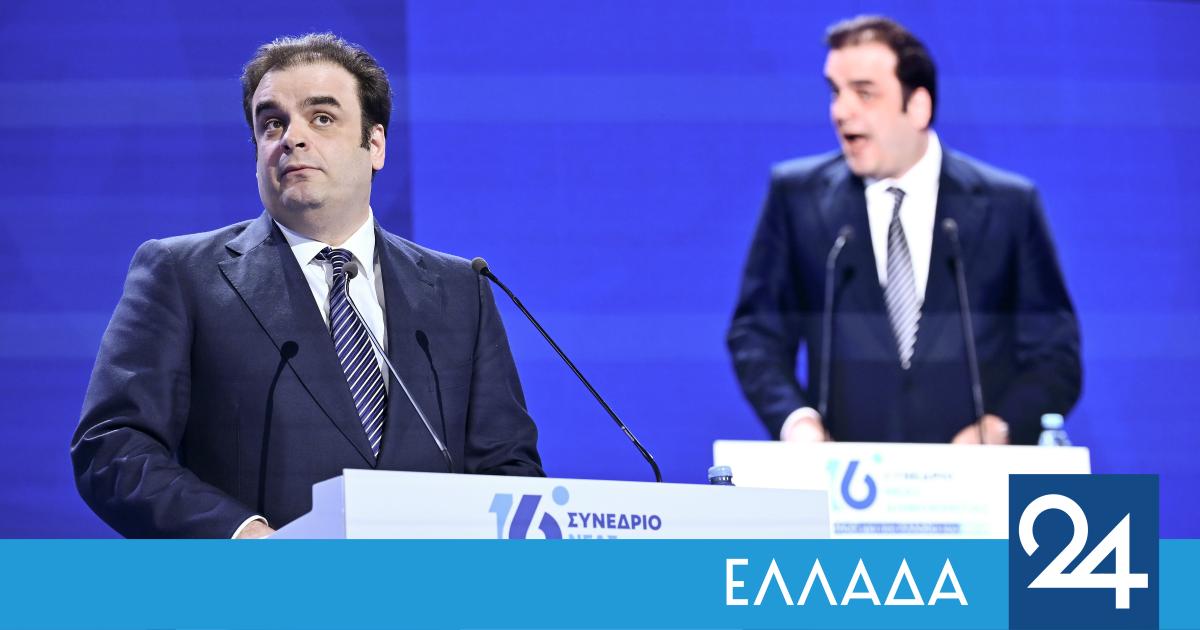
By the end of autumn, the Real Estate Acquisition and Re-leasing Agency will be operational, Minister of Economy and Finance and President of the Eurogroup Kyriakos Pierrakakis announced at the Economist conference “Investing in Change: Crete in Transition”, and is being held with the support of the Region of Crete and the Regional Development Fund of Crete.
In an interview with powergame.gr, the Minister said that “de facto it is a complex project to enable this entity to be implemented, in any case, now we are really in the home stretch. We are waiting for the binding offers immediately. And if I had to put it in a headline, I think the news is that this operator will be operational by the end of autumn.”
According to Pierrakakis, this institution is important because the truly vulnerable will be able to be placed in its care and if they cannot service the arrangement they are in, then the institution will acquire the property and with a state-subsidised rent, from 70 to 210 euros, for up to 12 years, one will be able to pay a rent and stay in their home and at the end of the period be able to repossess it. Thus creating a real safety net for the vulnerable.
The second policy, the Minister said, relates to the Extra-Judicial Mechanism. You can see, he added, how much we are investing in the Extra-Judicial Mechanism and I will also say how much it clearly affects thousands of households in our country every month. You have already seen that we have reduced the scope of the scope from 10,000 euros to 5,000 euros. So what is the intervention that we are going to make there? The intervention is that the citizen will be able to define the perimeter of protection himself, to say that I want to protect only my main residence and thus achieve both a higher haircut and a lower monthly payment.
He said that if these are now added together, these two policies together are the first comprehensive framework for the protection of the first home in our country, far from the judicial ambiguities and complexities of the Katseli Law. And to put it schematically, at the political level, a citizen who wants to protect his first home by servicing his obligations will not be left unprotected. No citizen in this country.
The Minister also said that less than 10 per cent of the auctions are for residential properties and when we say residential properties, we do not mean only primary residences. We mean secondary residences and holiday homes. “I say this so that we have a real sense of the scope of the problem, without of course claiming that this is not a problem to which we must respond, to which we must not respond,” he added, stressing that with the two policies (Real Estate Acquisition and Re-leasing Agency and Extrajudicial), “we are responding in the most complete way that the Greek government has touched this issue” .
Asked why the continuation of the subsidy on diesel and not on petrol was chosen, the minister replied that “the whole conception is a package of measures which comes at the moments when we have to intervene optimally. And so far we have supported the society with over 800 million euros in all the measures we have designed and are implementing. In this context, we have decided to extend the diesel measure for the following reason, with the 15 cents subsidy, which is 12 cents plus VAT.
Diesel is about how the energy crisis more broadly is affecting inflation. That is, what we call pass-through, how energy prices pass through to inflation overall, to the economy overall, we understand that it is clearer and more visible through the increase in diesel prices. And in that sense this is something that we have chosen to do as opposed to the other measures that are precisely targeted and parameterized and relate to specific social categories.”
He said that “here we wanted to do something that touches the whole economy through the supply chains and through the overall impact. Now, does that mean that we will not intervene further if we assess that the situation requires it? I answer. No. If necessary we will intervene further. But right now based on the data that we have, based on where the Brent price is, we judged that this is the move that we needed to announce at this time.
From there, we’ve proven it, not just in relation to the energy crisis, more broadly. When adequate fiscal space is made available, all of that space goes back to the people, it goes back to society. That’s what we’ve done in our recent announcements, that’s what we will continue to do in the coming period.”
Asked whether the structure of domestic production and the economy and the production model have changed after seven years of the country’s government, the New Democracy, and after five years of the implementation of the Recovery Fund, Pierrakakis said he believes we are on that path. “I believe that the production model is changing day by day. Let me mention two features, adding everything else. The first is investment in relation to GDP. We were at 11% in 2019, European average in 2021, right now we are at 17%,” he said. Adding that “so we are on a path, on a path of changing the production model in relation to investment.”
He cited exports as an example, saying “what was the production model that failed in 2008-2009? An inward-looking model based on consumption on imports and not on investment. I mentioned investment. In exports we were then at 20%, exports in terms of GDP, now we are at 42%. You will say to me, the European Union, the European average is 51%, I will answer you that we have not completed this transition, but we have covered a very large part of it, a very healthy part of it.”
And he said that “if you add that our country is now in fiscal balance, running surpluses, decelerating its debt faster than any other country in the world, not passing the burden on to the next generation, we are not at risk for 2032, as we have heard in the past; and of course, if you underline that we have an unemployment rate of 8% and very soon we will have an all-time low in unemployment, then all of this together establishes that it is a given that the country’s production model is changing.”
Pierrakakis accused the opposition of the usual contradiction in their criticism of the Recovery Fund, saying that “on the one hand they are calling for the Recovery Fund and on the other hand they are asking us in Parliament after the Recovery Fund what? ‘So, by saying that the Recovery Fund made reductions in the difference in the economy, it is fundamental to the contradiction of this criticism. Because indeed the Recovery Fund, because it combined programmes with reforms, plays a very, very important role in enabling us to implement the digital transition, the green transition, a number of objectives across the full range of productive sectors of the economy.”
He also said that Greece is also participating in a broader European debate, which has to do with cross-border mergers and acquisitions, with how, for example, the Greek stock exchange became a member of the Euronext network, with how a systemic bank became a member of the Unicredit network (Alpha Bank). “We are entering a broader European debate, but in terms of twice the European average growth, in terms of convergence,” he added.
Summing up on this issue, he said that “the productive model of our country is changing day by day, political and fiscal stability is needed to continue this journey, to achieve this change. It would never change in a day or in a week. It takes systematic work to be able to achieve it. But right now we’re on a path that is achieving that. I won’t claim that there are no difficulties. I’m not going to claim for the people who see us that there are still not enough problems that we need to solve.
But we now have, if you like, a shift in the lesson that problems are not solved by a law and an article. They are solved with systematic work, with a plan, with a plan, with a will and above all with faith and with the belief that it is absolutely possible for our country to get to where it deserves to be.”
Asked about the opposition’s accusations that it is a government of serving big capital, when salaries and property income should be taxed at as much as 45 per cent while dividends and corporate profits at just 5 per cent, the minister responded that this “is another contradictory criticism of the opposition because the same opposition that says this is the one that overtaxed the middle class and the one that as Syriza started to reduce the dividend tax that you mentioned, took it to 10% when we took over.”
He said it was “the government that made the biggest direct tax cut in the post-independence period, that it was a direct tax cut that targeted the middle class, targeted families with children, targeted young people entering the labour market, we are zeroing the tax rate for young children up to 25 years old who are starting their labour market journey. We are a government that has increased the minimum wage by 46%.” He added that the minimum wage was at 650 euros and will rise to 950 euros next year. All this is the journey of a government and a country that is trying to support the whole of society. And I think this is amply demonstrated by the data.
He went on to say that “and again, there are problems. But every step of strengthening that we take overall for the country will be about and will concern all and sundry. Beyond that, let me dwell a little more on dividends. You know, we received 2019 from SYRIZA with a 10% dividend tax. At that time, the total amount declared was 1.7 billion and we received a tax of 173 million. Once we went to 5% from 1.7 billion, do you remember how much was declared? 5.7 billion and we got 288 million in revenue the following year. That was in 2020. In 2024 from 5.7 billion now we went to 7.7 billion and 386 million was declared. So, it’s all part of an equation that at the end of the day draws more revenue for the state budget and so we are able to support more and more on more and better. And more generally, what do we want to do as a government, what do we seek to do as a government? To remove burdens.”
He reiterated that “we cut 83 taxes and contributions. And I will tell you something, still the taxes are high relative to what we want to achieve. We want to achieve even greater reductions, for citizens, for the vulnerable, for businesses. But I think people know very well that we have the credibility to tell them the truth. We will cut taxes, we will support society more and more as we create the capacity to do so, the fiscal space to do so. Anything else is out of touch with reality and is the same political vocabulary that has failed time and time again over the past decades. It has been passed on, let me say, to my generation and to all the new generations who are trying to enter the labour market. Now we and will not pass the bill on to the next generation and will continue to support the whole of society and the economy.
Greece can achieve truly spectacular results. It is already doing so. It is entirely possible if we systematically continue our hard and focused work.”
Finally, on the polls that in recent years show a large credibility deficit both on the part of the opposition and on the part of the government that seems to be unconvincing the electorate, and although since there is no opponent for New Democracy, why is the government losing popularity and whether in the future there is a question of losing the advantage of political stability that it currently has at this moment or for which it is a great asset both for the economy and for society, the minister said that “it is
He said that “as far as the opposition parties are concerned, in no case should any of us underestimate them, underestimate the opposition; the debate is on proposals, not on persons. There is a comparison. The Prime Minister, Mr Mitsotakis, is being compared with Mr Tsipras, with Mr Androulakis, with all the political leaders. Politics is not conducted in a vacuum. It is conducted in real conditions. And the people make their assessment today in the polls, tomorrow at the ballot box. It is the programs and solutions, the practices that will ultimately be compared.”
According to Pierrakakis, “from the historical lens we are in our seventh year of government. By itself in the seventh year of governance there is a normal attrition. But as far as we are concerned, I think people know that we are the only ones who can provide practical solutions to all the problems they face. The issue that we talked about before the debate on first home protection you see the government coming in to answer that in a very practical way. I have not heard any practical positions from the opposition. I have heard wishful thinking.
So we are comparing the problems and under the historical lens the fact that New Democracy is listed first by more than 15 points from the other opposition parties in the polls. It is also a reflection which, let me say, has no historical precedent. So we know who our opponent is. Our opponent is the problem. I’m not going to get tired of saying it. The problem at hand.”
And he concluded by saying that “as long as people have problems, their problem is our problem and we will continue to work in that direction because that is ultimately what makes the difference. Not the political quote, not the political slogan, the political solution.”