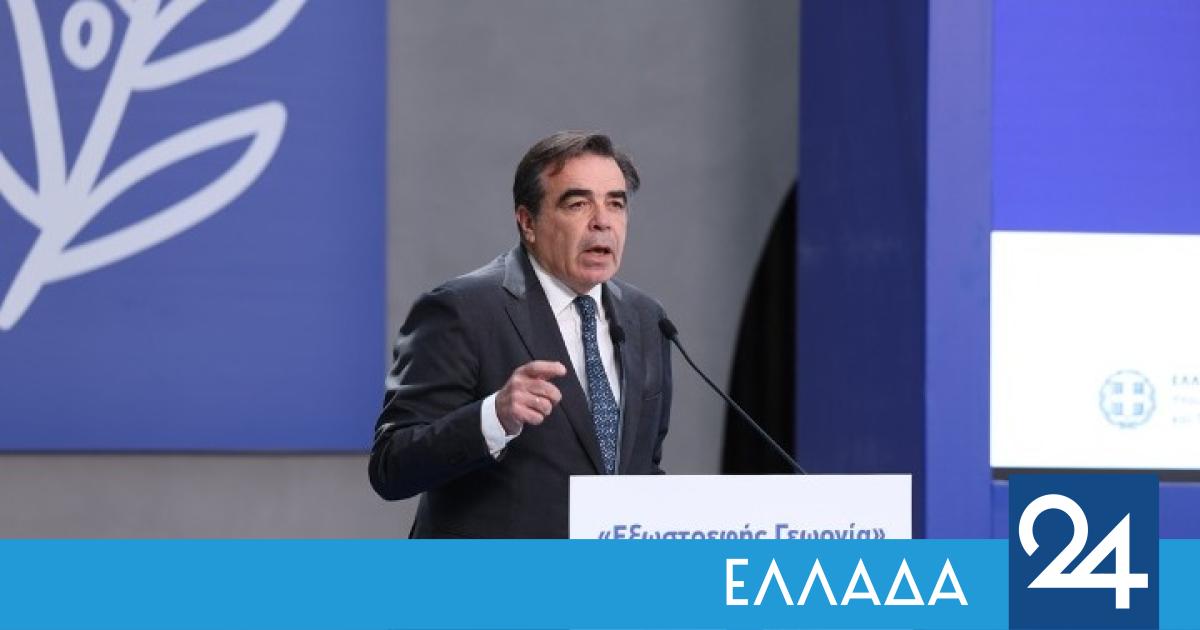
The image of Greek agri-food abroad is stronger than ever, underlined the Minister of Rural Development and Food, Margaritis Schinas, in his speech during the presentation of the project “Reverse Agriculture”, at a joint event of the Ministry of Rural Development and Food and the Ministry of Digital Governance, in the presence of the Minister, D. Papastergios
This project is being developed on a multi-level basis, aiming to develop the extroversion of Greek production, the primary and secondary sector of Greek agriculture, utilizing digital infrastructures, information systems and innovative technologies that enhance competitiveness, the promotion of Greek products and their interconnection with international markets.
Mr Schinas focused in particular on the relationship between Greek food and quality, describing the 121 PDO and PGI products available in the country as an “indication of wealth”.
“The bet is not to meet new pharaonic plans and visions, but to build on what we have in front of us,” he said, stressing that Greece has everything it needs to gain a strong position in international markets: not only products, but also people.
At the same time, Schinas stressed that extroversion cannot be limited to numbers. “You cannot have only one good product. You have to tell the story, you have to make others fascinated,” he said, stressing the need for the Greek product to be accompanied by a narrative, quality and consistency.
He also stressed that true extroversion “does not come about through a Presidential Decree or a Ministerial Decision, but is built on a daily basis.”
“It is built,” he said, “when the producer believes in his product, when he cooperates, when he invests in quality and when the businessman understands the producer’s effort and anxiety.”
According to the data he cited, in recent years, exports of agricultural products and foodstuffs have been steadily increasing, with a new increase of 6.5% recorded in 2025. Of particular importance, he stressed, is that today one in four products exported by Greece to the world comes from the primary sector and food processing.
Mr Schinas also said that in the discussions he has held in recent weeks, he has noticed the admiration of his interlocutors for the potential of Greek agri-food. “I feel it as a responsibility and a great opportunity,” he said.
He concluded by stressing that the country must now move from individual successes to a more organised national strategy of extroversion. In this direction, he described the initiative on “Outward Oriented Agriculture” as important, as he said it can unite production with innovation, technology, knowledge and international networking.
The aim, according to him, is to create a new ecosystem of cooperation between the state, the market and the people of production themselves.
D. Papastergiou: “With deeds and not with words next to agricultural production”
For his part, Minister of Digital Governance Dimitris Papastergiou raised the issue of upgrading the sector, noting: “I will talk less because in the conversation I think we can develop much more about how today agriculture needs to move to a next day. The core of the issue is what the Minister outlined earlier. But the way in which we do it is one that today needs to go through a new perspective, the one that we have given to the Outward Agriculture project with the Information Society.”
The Minister explained how the project has evolved to meet the real needs of producers: “And indeed this project started with a structured strategy of extroversion, but along the way, and it was this way that went through the infill of OPEKEPE in recent times, it came to add something else very important. The part that we put as primary in relation to the dialogue that the Ministry of Rural Development had with the agricultural world on the issue of Greekization.”
He went on to elaborate on the solution proposed by the Ministry of Digital Governance: “We have found, and it was part of the option of the project, a first way to approach such a major issue for the farmers of our country today. In other words, how we can take a first easy approach to finally see what is produced in Greece, to quantify it, to compare it with what is sold, so that we have this first balance, the first balance of Greek products.
Referring to the technical means, Papastergiou revealed the use of space data. There are various techniques and together with Margaritis it will be a real pleasure for us to stand by all the wishes of the new Ministry of Rural Development, this new beginning that has been made in order to actually be able to provide solutions. And the solutions are solutions that are more or less obvious, solutions that come from the earth but also from the satellites.”
Speaking about the country’s satellite infrastructure, he said: “Today the first 17 micro- and nano-satellites are already passing over our country. Some of them have technologies compatible with agricultural production issues, with such precision that can give us very good detail on what is produced, how it is produced, what disasters we have had and of course give much more detail on predictive models which are very useful for production quality.”
In concluding his statement, the Minister of Digital Governance sent a message of confidence: “So all this in a new Greece and in a government that gives basis and weight to how it will stand by with deeds and not with words in agricultural production. It is our pleasure to move forward and take the next steps in the most technically sound way. I am very happy to be part of this project.”
The role of technology in the modernization of agri-food was highlighted by the CEO of the Information Society, Stavros Asthenidis.
As he noted, this is an integrated intervention of digital transformation, implemented in the framework of the Recovery and Resilience Fund “Greece 2.0” and shows how technology can serve production and the real economy.
Astenides noted that Greece has all the tools to strengthen its position internationally, such as quality products, a strong gastronomic identity and a recognizable national brand. The challenge, he stressed, is to exploit these advantages through a modern digital ecosystem that will connect the producer with the market and the Greek product with the consumer, in Greece and abroad.
The focus of the new project is the creation of a digital ecosystem that connects the producer with the market and the Greek product with the consumer, in Greece and abroad. The Easy Agro Expo platform reduces bureaucracy in exports, speeds up the issuing of certificates and makes it easier for businesses.
Through Greek Farms and digital exhibitions, Greek products acquire a unified, modern and multilingual presence internationally, highlighting quality, identity and local history.
Finally, he stressed that “Reverse Agriculture” is not the end of a journey, but the beginning of a more modern and dynamic agri-food Greece, which uses technology, invests in knowledge and claims its place on the world map.
Achilleas Kanaris, President and CEO of Vodafone Greece, presented “Reverse Agriculture” as a project of wider significance for the state, producers, businesses and citizens.
As he said, the project was developed in two phases and includes digital platforms, information systems and communication actions, aiming to modernise the agri-food chain and strengthen the presence of Greek products in international markets.
The central role is played by the Greek Farms portal, which functions as a digital showcase of Greek agri-food. The platform is available in eight languages and includes more than 500 original articles and over 200 videos on Greek PDO products, linking production with tourism, history and culture.
At the same time, the Easy Agro Expo platform centralises administrative procedures and transactions, reducing bureaucracy and facilitating exports. More than 200 new digital services for businesses have already been posted on Gov.gr.
Special emphasis is also placed on the use of data, through Business Intelligence systems, as well as the monitoring of imports with digital tools.
Canaris finally stressed that even a 1% increase in the country’s export effort can, over a decade, lead to €1 billion more exports.