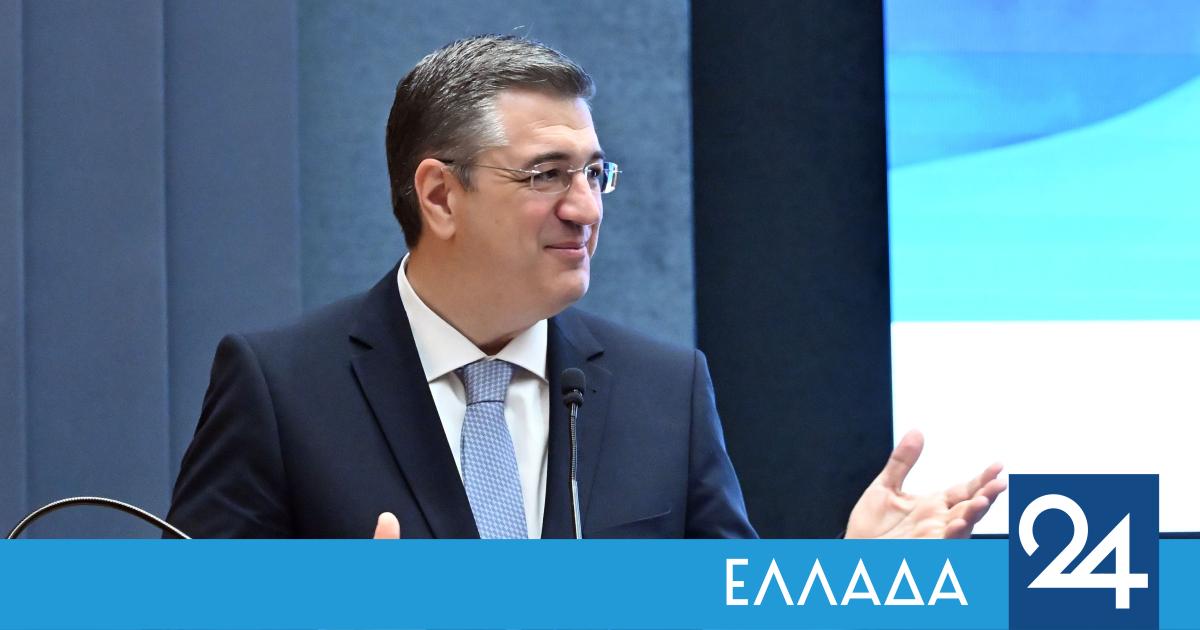
277 million euro grant from the CEF, the EU’s infrastructure and transport budget. was handed over today to the Minister of Infrastructure and Transport, Christos Dimas, by the Commissioner for Sustainable Transport and Tourism, Apostolos Tzitzikostas, for the start of works on the road and railway section of Alexandroupolis-Pythiou, with a total length of 68.3 km.
In his speech, which took place in the framework of an event organized by the Representation of the European Commission in Greece -at Warehouse 1 of the Alexandroupolis port- for Europe Day, Mr. Tzitzikostas noted that this funding is practical proof that this project is the top priority of the European Commission and of the European Commission as a whole.
The new European rail and road axis
Describing the importance of the project, he said “It is one of the largest transport and infrastructure projects to be implemented in Greece in the coming years and strategically it is the top project. A link in a major European railway and road axis connecting the Aegean Sea with the Black Sea, Thessaloniki and Alexandroupolis with Bucharest. A project that upgrades Thrace, upgrades Northern Greece and at the same time upgrades Bulgaria, Romania and the entire Eastern Wing of the European Union”. He stressed that this project means faster transport, safer routes and new opportunities for businesses, the supply chain and exports, new opportunities for our ports and boosting tourism. It means access, growth, security.
The new geography and the Straits bypass
An interconnectivity which, he explained, has three critical dimensions:
-The military mobility. The ability of the EU and NATO to move military forces and equipment – in a changing world – is, he said, a matter of strategic readiness and collective security
-Competitiveness, trade and exports. Producers and businesses will now be given the opportunity to export faster and cheaper to Eastern and Central Europe.
-Tourism, which he said is not just about image and promotion but access, security and infrastructure.
Alexandroupolis and Thrace on the new European map
He also described the project as a historic-scale reversal as “in a region of deep history and culture but also of harsh conflicts, connectivity is now becoming a tool for peace, cooperation and common development”, with Alexandroupolis and Thrace on the new European map. On the map of transport, energy, security, defence, competitiveness.
Calling for a greater European transition in which the choices, the design of European and national strategies – which meet at the same point – are part of, he noted that Europe is facing a changed world (geopolitical tensions, the need to protect supply chains, migratory pressures at external borders, the crisis in the Middle East, the war in Ukraine, etc.) and that the European Union is facing a new world.etc.) must become not only a Europe of peace but also a Europe of power. A power that protects and guarantees security.
The power of the European Union today
Outlining today’s European Union, he stressed that its strength lies not in the fact that it is an economic power of 450 million citizens with a GDP of 17 trillion euros, but in its ability to turn crises into springboards. It has the maturity to openly discuss its mistakes, listen to criticism and correct them. He stressed Greece’s leading role in shaping the new European policy and expressed the view that the trilateral cooperation between Greece, Bulgaria and Romania is the new pillar of stability in the Balkans, sending the message that Greece’s borders are impenetrable but its roads are always open for creation and prosperity.
The Thrace of Europe, the European Thrace
Addressing the citizens of Alexandroupolis and Thrace, he said that today he presented the Europe of projects and not the Europe of elites that many people talk about. The Europe that recognizes the sacrifice and strategic importance of Evros and returns to its citizens the security and development they deserve.
Finally, referring to today’s Europe Day, he said that its heart beats in every region of the European territory and today’s event in Thrace is indicative of what Europe, European solidarity, European funding, common strategy means today. What it means a project that starts in Greece but concerns the whole of Europe.
“So from Thrace, it is valuable to understand that in these places, in this place, Europe ceases to be a theoretical concept or a bureaucratic mechanism. It becomes practice, it becomes security, it becomes a perspective…”, Mr Tzitzikostas said, adding that during his visit yesterday to the borders and the Operations Centre at Alexandroupolis Airport and the LNG Regulatory Station in Amfitriti, he saw the image of a Europe that protects, that does not leave the borders to their fate, that cooperates, that coordinates services, that uses technology, people, experience and institutions. A Europe that safeguards its energy security in a period of intense turbulence. “Europe is investing here, because this is where the resilience of the entire Eastern Wing of our Union is built,” he said.
The event was attended by the Minister of Infrastructure and Transport Christos Dimas, the Deputy Minister of Transport Konstantinos Kyranakis, the Consul of Romania Georgiana Gabriela Iacobuta, the Consul of Bulgaria Anton Markov, the Head of the European Commission Representation in Greece, Niovi Rigou, the Mayor of Alexandroupolis, Yannis Zamboukis and the Regional Governor of A.M.Th. Christodoulos Topsidis.