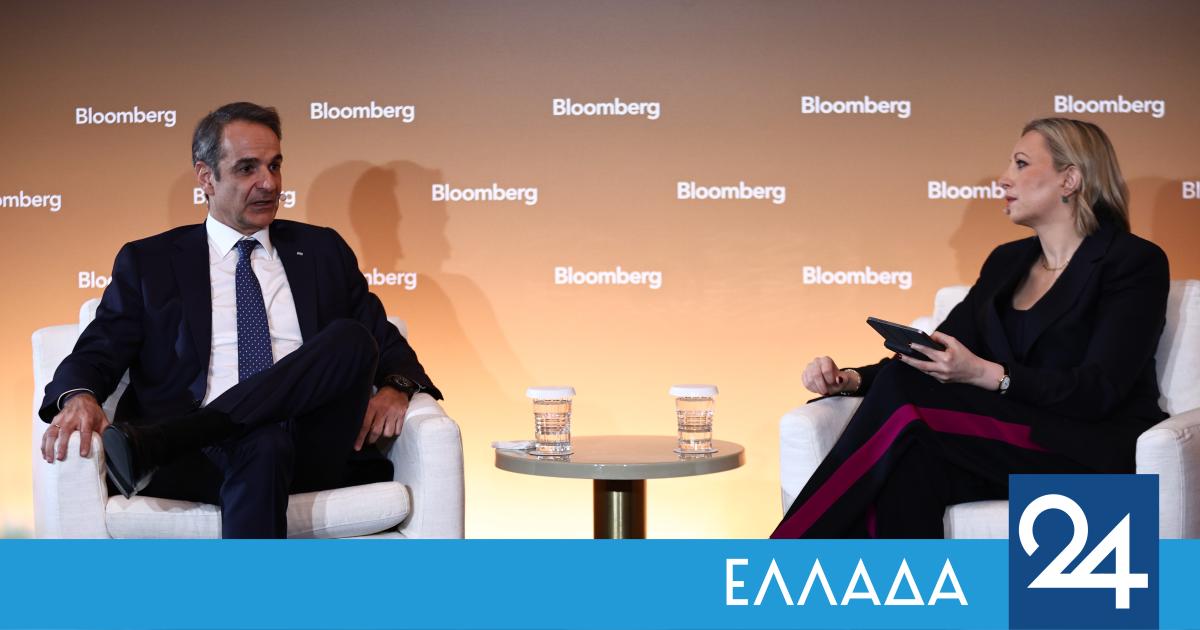
At the beginning of this crisis, Greece expanded its geopolitical and defence footprint to meet the needs of Cyprus. We were the first country to send two frigates and four F16 aircraft in response to the call for help from our Cypriot brothers and at the same time we responded and contributed to strengthening Bulgaria’s air defence, Prime Minister Kyriakos Mitsotakis said in a discussion with journalist Francine Lacqua at the “Greek Energy: The New Era” conference organised by Bloomberg in Athens.
He stressed that Greece is not only doing its job in terms of its defence posture but encouraged other European countries to join in, sending a clear message that the Eastern Mediterranean must be a top priority area for the whole of Europe. And this was a positive step in the right direction, the Prime Minister said.
As far as the Persian Gulf region is concerned, the Prime Minister said that Greece has consistently supported the EU’s Operation Shields for the protection of navigation in the Red Sea and around the Horn of Africa.
On this point he commented that unfortunately Operation Shields did not have the support of all European countries and stressed that this operation was clearly defined geographically and did not extend to the Straits of Hormuz and the Persian Gulf. So the answer is that “no Greece is not going to participate in any operation around the theatre of operations that are going on and I doubt there is much European appetite for such a mission at this stage.”
In response to a question about what Greece would say if asked directly about participation, the Prime Minister said that we would not get involved in any action in the wider region while military operations are ongoing. We have been clear from the beginning. We have strengthened our defences and of course we have a strong interest in freedom of navigation, and Greek shipowners are also concerned about what is happening in the wider region, and unless there is a European-sanctioned mission – which is not the case today – Greece will not participate on its own and the likelihood of such a mission is very small.
He also said he believes that Europe will not get involved militarily but should focus on the economic consequences of the crisis. He stressed that the importance of the upcoming European summit is great and there should be management of the economic and energy implications.
He also said that things would be different if the crisis lasted a few weeks and different if it lasted months. He assured that our country is acting for a quick de-escalation pointing out that we do not believe that the issues in the Middle East can be solved militarily but at the same time we believe that Iran should not have nuclear weapons and cannot threaten its neighbours.
He reiterated that Europeans must focus on managing the consequences of what could turn into a very significant energy shock.
He said that no one can predict the end of this conflict but expressed hope that it will not last long, pointing out that the longer this crisis lasts, the greater the risk of negative spill-over effects.
The Prime Minister pointed out that the way Europe handled the energy crisis in 2022 after the Russian invasion of Ukraine needs to be analysed in detail, what worked and what didn’t work at the time.
He stressed that it is very important for Europe to have a plan of short and medium-term measures ready to be activated in case we need to support our businesses and consumers with energy prices.
He said that looking at the price of electricity should emphasize that a positive assessment of our country’s energy policy is needed. We are investing in renewables, we are using natural gas, wind energy (we had a good performance in the first quarter), hydroelectricity, we can keep prices low and Greece is becoming a major net exporter of electricity which has never happened before and it is a great success. He also said that the policy of keeping low prices sends a message on how we should shape our future energy mix.
On the closure of the Strait of Hormuz, he said that apart from the geopolitical risk, the problem of blocking the flow of oil is great and no one knows how long the crisis will last. In Greece we have not seen the consequences because our energy policy has worked but it matters how the situation will evolve especially with regard to the price of diesel, which can affect inflation.
The Prime Minister also spoke about the structural problems in Europe’s energy policy, pointed out the usefulness of interventions to enhance competitiveness and that it is a fact that Europe needs to import energy. In this context, he referred to the exploration of hydrocarbons that is starting in our country. He stressed the need to look at the prospects for development in the clean energy sector at the European level without undermining the competitiveness of European industry in the process.