The Greek defense industry is making a leap that surpasses even countries like Iran, and the road is just beginning.
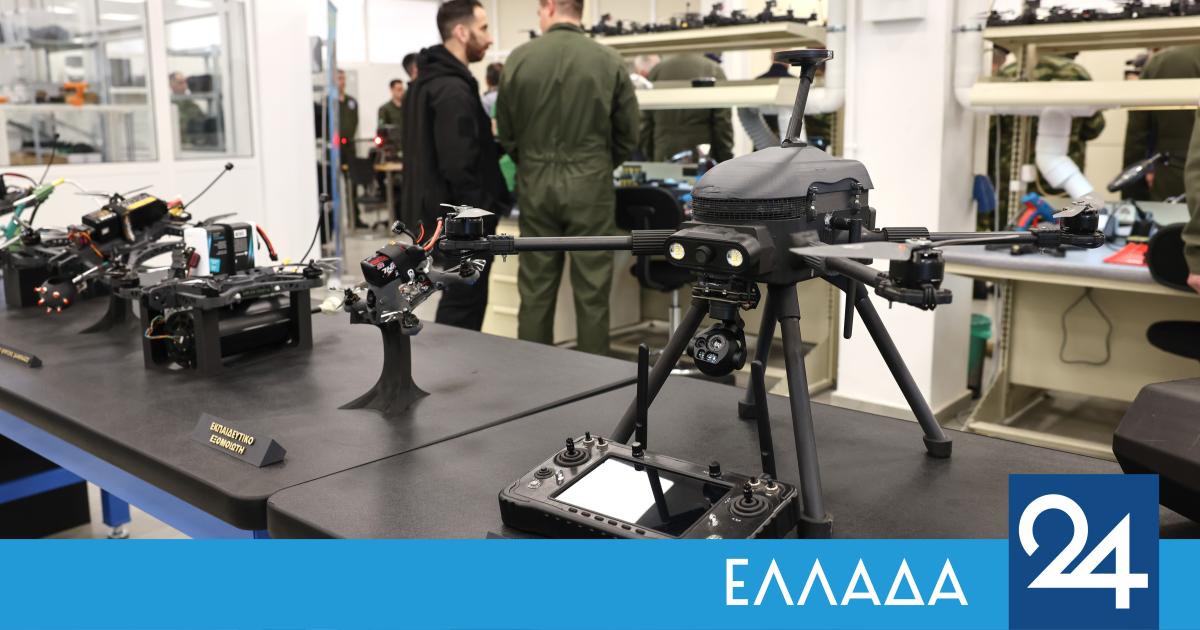
When National Defence Minister Nikos Dendias visited the 306 Telecommunications Base Plant (306 EBT) in Acharnes, accompanied by the leadership of the Hellenic Defence Forces and the General Staff, it was not a formal visit. It was the official presentation of a bet that Greece has decided to win: to build domestic defense power in the age of drones.
The two Greek factories – the 306 EBT in Acharnes and the 316 Technikon Area Workshop in Toxotes Xanthi – now produce a total of 4,000 drones annually. This number is not just impressive by Greek standards; it is impressive globally.
To put the scale into perspective: according to international media reports, Iran – a country that has invested decades in developing drone programs and exporting them to war zones – produces somewhere between 2,800 and 3,500 units annually. Greece, then, with its current production capacity, is already surpassing or matching one of the world’s largest producers of drones.
Target: 1,000 Drones per month
If the above seems ambitious, the Greek Army’s actual target is breathtaking: 1,000 drones a month, or 12,000 a year – triple the current production.
The Minister of National Defence was clear: “We have established two drones production factories, we have established two Mobile Drones Production Units, and we are in the process of building mobile production units that will accompany all the Brigades of the Greek Army in the foreseeable future. Each Brigade will be able to produce and repair drones on site.”
This is a vision of radical decentralization: instead of one or two large factories that are easy targets in case of conflict, Greece is building a scattered production network that cannot be neutralized in a single strike.
Four Kinds, One Philosophy
Four categories of unmanned aircraft are produced at 306 EBT, covering a wide range of operational needs:
1.Small reconnaissance drones for frontline units
2.Cargo drones for battlefield resupply
3.Kamikaze drones with ammunition for strikes against enemy targets
4.Fixed-wing drones for use by the Artillery and Air Force
Behind all this is a simple but powerful logic, the “Low Cost – High Effect” philosophy: a drone costing 1,000 euros can take out an enemy vehicle worth millions. This asymmetry changes the logic of war – and Greece has figured it out.
Strategic Autonomy: The Response to Evros and the Aegean
The program is not detached from geopolitical reality. Production is directly aimed at decoupling from imported solutions and directly meeting the needs of the units located in the most sensitive regions of the country: the Evros and the eastern Aegean islands.
The idea of mobile production units per brigade is no accident. It is an answer to a crucial question of survival: if a small country cannot compete with the giant industrial production of great powers, what does it do?
A Step Too Late – But It’s Here
It is true that Greece was not a pioneer in this area. Other countries, large and small, invested earlier in drone technology. The quadrupling of production – from 1,000 to 4,000 units a year – represents a geometric advance that until recently seemed a distant prospect.
But the step has been taken. And it was done with clarity, measurable goals and public commitment from the leadership of the Department of Defense. Greece is no longer just claiming a place on the defence industry map – it is claiming a place among countries that produce real deterrent power with their own hands.
Source:NewsAuto.gr