The South American language Capanahua was spoken – according to the most recent inventory of endangered languages – by just 50 people in Peru. High school students in Greece have managed to decode it, as well as the endangered Nile-Saharan language Tabak from Sudan (about 800 speakers), but also the indigenous Guarao language from Venezuela and Tamil, along with the Dravidian language of India, which is not related to the official languages of India but is spoken by 86 million people.
A total of 211 students from Northern Greece and 300 from Central and Southern Greece became “linguists” for one day, participating in the 2nd Student Linguistics Olympiad, organized jointly by the Linguistics Departments of the Departments of Philology of the University of Athens and the Department of English Language and Literature of the Aristotle University of Thessaloniki, as well as the Department of English Language and Literature of the Aristotle University of Thessaloniki. The competition was held on 14 February in Athens and Thessaloniki and the examination centres were university lecture halls of the Departments of the University of Athens and the Aristotle University of Thessaloniki. Now, the students who excelled will be awarded by the two universities at respective events, while four students – one from Thessaloniki and three from Athens – who achieved the highest scores will form the national team that will represent Greece at the International Linguistics Olympiad, which this year will take place in Bucharest, from July 26 to August 2, 2026.
“The International Linguistics Olympiad is an institution that was established two decades ago – this year will be the 23rd International Olympiad – and for a country to be able to participate in it requires the organisation of a national competition, which we now have.” Spyridoula Varlokosta, Professor of Linguistics at the University of Athens, told APE-MPA, explaining that the aim of the Greek event is for students to come into contact with the subject of Linguistics and to approach it scientifically through real data, in order to understand the mechanisms by which the human mind produces speech.
This competition is different from most student competitions, as it requires absolutely no preparation or prior knowledge. Students are asked to activate some particular mental skills, combinatorial, critical and analytical, which are in fact the main mental tools of the comparative and theoretical linguist.
.
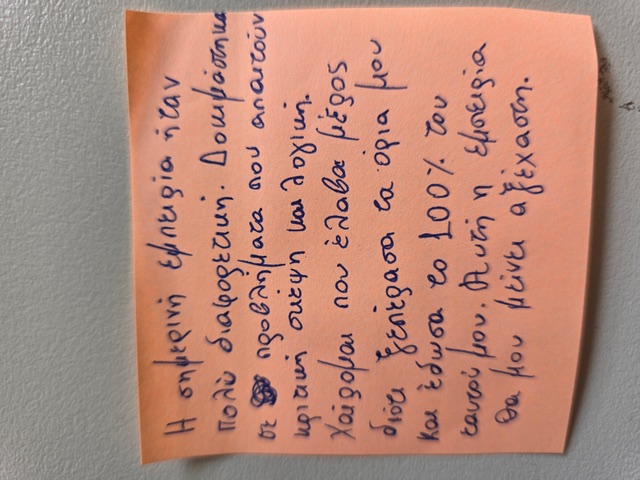
“The experience of the exam is quite similar to solving a puzzle or a sudoku, as it does not require prior knowledge, but activates analytical and synthetic thinking, so students treat the competition as a decoding game, looking for patterns and rules through linguistic data of different languages,” Anthi Revithiadou, professor of Linguistics at the Aristotle University of Thessaloniki, told APE-MPA. As she explained, the students coped with the demands of the two-hour written competition, staying until the end, trying to answer the questions.
The puzzles that the contestants were asked to solve were based on three basic subsystems of language, namely meaning, phonological form and syntax. There were several students who excelled in two areas and did not do equally well in the third, while the most difficult part for most proved to be nasalization, which in phonology refers to the process by which a phoneme acquires a nasal tone.
“Students are excited when they are exposed to languages they didn’t even know existed, especially languages in danger of extinction, such as those chosen for the topics of this year’s competition,” noted Ms. Varlokosta, adding that what is evaluated is the way of thinking, analysis and reasoning that leads to the solution.
The first Student Linguistics Olympiad in Greece was held in 2025 and the winners of that competition were the first national delegation to the International Linguistics Olympiad, held in Taipei, Taiwan.
Today, the Linguistics Departments of the University of Athens and the Aristotle University of Thessaloniki seek to expand initiatives to highlight the importance of Linguistics in the modern era, as, as noted by Messrs.Varlokosta and Revithiadou, there is a great demand for linguists internationally, especially in the field of artificial intelligence, where understanding the structure of language is crucial for the reliability of language models.
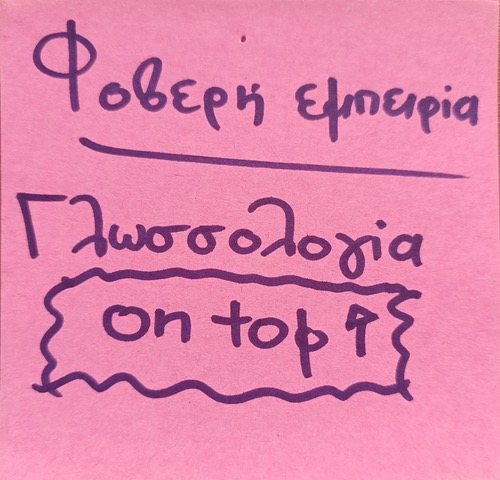
As they explain, Linguistics is a field directly linked to modern developments and modern models need linguistic knowledge, i.e. to be trained in how language is structured, how its elements are connected and how they are organized into systems.
Furthermore, the aim of the organizers of the Student Linguistics Olympiad is to strengthen the overall presence of Linguistics in education, through the institutionalization of Linguistics Clubs in the school curriculum and the more active involvement of the educational community in the organization of the competition. In this year’s Student Olympiad there were students who represented their school units in an organised way, but also students who came individually, without even informing their school about their participation. This year’s event was supported by the Deaneries, the Rectorates and the Asset Development and Management Companies of the two universities, while the contribution of dozens of volunteers was significant.