For many years, man’s deepest need, especially in the difficult times he faces, to turn to God and the Saints has been a safe haven. In whatever God one believes in. This inner need, often beyond prayer, is often transmuted into a personal dedication, a promise. Or a vow as it is more commonly known.
In Rhodes, from the “stone” years of the Ottoman and Italian Occupation onwards, people’s faith often became a personal vow to God and the Saints. And to this day, in the hundreds of monasteries and holy temples that exist all over the island, the dedications to the Saints have an important, silent but at the same time leading role, in the difficulties and trials of visitors who are not necessarily Christian Orthodox.
As Metropolitan Kyrillos of Rhodes, speaking to the Athens-Macedonian News Agency, points out, “vows are a timeless, inter-religious and deeply personal expression of faith, gratitude and invocation.
The Orthodox Church accepts them as symbolic and spiritual acts, which express the recognition of God’s power or the grace of the Holy One. In essence, an act of trust in God.”
Asked whether the Church encourages vows or sees them more as a personal expression of faith, the Metropolitan of Rhodes stresses that “it is certainly a personal expression, but the concept of a vow can be said to be a promise of offering to God, to the Saints that accompanies a prayer, a wish, a request and is based on the faith that the Church accepts, that God and the Saint can intervene in the life of man to give him healing, protection in a difficult situation, blessing in general.
And I stress again, of course, that for the Church the vow is not a magical act, i.e. I make a vow, God is bound to respond to my vow. It is a symbolic and spiritual act, which expresses the recognition of God’s power or the grace of the Holy One that he has and also underlines the commitment of the faithful Christian to keep his promise.
The vow existed among the ancient Greeks. Vows are common to all religions. It is mainly an expression of gratitude to God or the saints for something a person has received from God. And on the other hand, it is also an appeal, a promise for something that man asks for. And, of course, it concerns the religious consciousness of all peoples and all religions in general.”
As a child, he remembers with emotion, in Crete where he grew up, a vow that always made an impression on him. You understand when we have temples on mountains that have paths going through the thorns. You understand what it was like for a man to walk like that for an hour to fulfill his vow.
There was also the crowd of black-robed women who gathered at Agia Marina in Heraklion. It was a vow for a serious health issue, for example, where they would say get well and dress in black for a year. And I saw dozens of women all wearing black as if you were watching a silent funeral.”
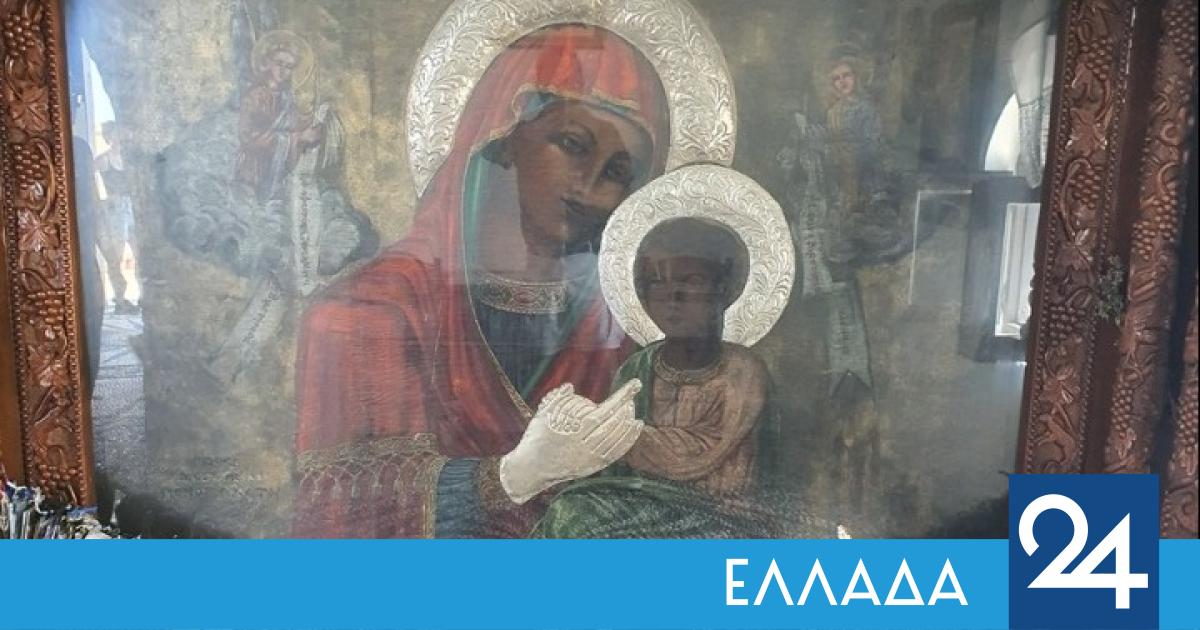
The Virgin Mary Chabika (the Tall One) – The childbearing vows that even made a Muslim baptized as a Christian
In Rhodes, Panagia Tsampika stands out for its childbearing vows. And indeed, the visitors are not only Christian Orthodox, but people from all over the world who start coming to Rhodes for this purpose: To climb 305 steps at an altitude of 287 meters to the top of the mountain.
This is one of the most famous pilgrimages in the Dodecanese, where among the thousands of visitors are hundreds of childless couples who invoke her help to have a child. As a sign of gratitude, when a child is born, depending on its gender, it is given the name Tsampika or Tsampikos in her honour.
It is not known exactly when the monastery was erected. The iconostasis, according to an inscription, was made in 1693 with the sponsorship of Hieromonk Gabriel. On the surfaces of the walls inside, fragmentary frescoes of the post-Byzantine period survive.
“The grace of the Virgin Mary reaches to the ends of the world,” the Metropolitan of Rhodes said in a statement to AP – MPE. It is not only Greeks who go to Panagia Tsampika (both low and high) to worship and pray for procreation. There are couples of Muslims and Catholics and Protestants from Germany and the Netherlands. And all of these children are given the name Chabikos or Chabika. I know many couples also from Crete who have named their children this way, in honour of the Virgin Mary. A Muslim also, as we know, who lives in Germany and who visited the Holy Monastery when their child was born – and therefore their vow was fulfilled – asked to be baptized a Christian himself. They did not come to Rhodes for this purpose. They were a childless couple. But when the guide informed them of the power of our faith, they went there, knelt down, prayed to the Virgin Mary. They had been trying for many years to have a child. And when he came into the world, they named him Chabika. I personally know of two other such cases of people of other religions from Europe. There will certainly be many more, from all over the country and all over the world.”
The tombs in the sacred monasteries of Taxiarchis in Rhodes
In addition to Symi and Panormitis, where tens of thousands of visitors each year visit the monastery, there are also the holy monasteries of Taxiarchis in Rhodes, where truly hundreds of people, mostly locals , silently leave their own vows, with the expectation of receiving his grace.
The Holy Monastery of Tharrios (Archangel Michael) in Laerma is one of those monasteries where the faithful choose to pray and also to deposit their offerings. With faith, with reverence and quietly.
Metal vows depicting various parts of the body, wooden carved icons, wax figures of human organs, up to candles of various sizes, make up this unique act of faith. Man to God.
And many believers, in very many churches, after a health ordeal, mainly involving an injury, choose to leave crutches or gauze in the holy temples or monasteries of their region, as thanksgiving for the end of their ordeal.
We have tamas in all the churches and monasteries – notes the Metropolitan of Rhodes: “We have either swords or metal shoes. What does this symbolize? It symbolizes that because the Taxiarch holds the sword, let’s say we take a sword to him as a gift. And the metal shoes correspond to the fact that he runs everywhere, so according to popular belief, he changes shoes. Yes, we have popular beliefs, which of course have no theological background, but they essentially express how the believer feels, how the faithful feel about the Taxiarch.”
Agios Minas in Kalithies
Agios Minas in Kalithies
A unique chapel located in the area of Kalithia, Rhodes, and which receives dozens of vows every year, is that of Agios Minas. These votive offerings are neither metal nor wooden icons nor wax figures. There, the faithful tie a ribbon to a tree next to the chapel as a sign of a personal vow. And they make their own wish, with the expectation that St. Minas will grant it.
Saint Philemon in Arnitha
In the village of Arnitha, Rhodes, there is the Holy Monastery dating back to 1839. The Holy Monastery of Saint Philemon. Within a saint who was worshipped predominantly in Constantinople. As the Metropolitan of Rhodes explains, this monastery was a refuge for people with mental illnesses during the years of Turkish rule. In fact, a sanatorium for mental illnesses, the existence of which is directly linked to the popular tradition that St. Philemon was a psychiatrist in Gaza in Asia Minor.
The organisation and operation of this original and peculiar clinic was so exemplary that the attending monks kept a record of the history of the patients’ illnesses, which was destroyed during the Italian occupation. The vows, which have been dedicated to the monastery over the years, are related to the mental illnesses of our fellow human beings. And in the Codex of the monastery, from the testimonies that exist, these vows over time amounted to hundreds. And they corresponded to human, mental suffering, for which in those years, there were no medicines and cures.