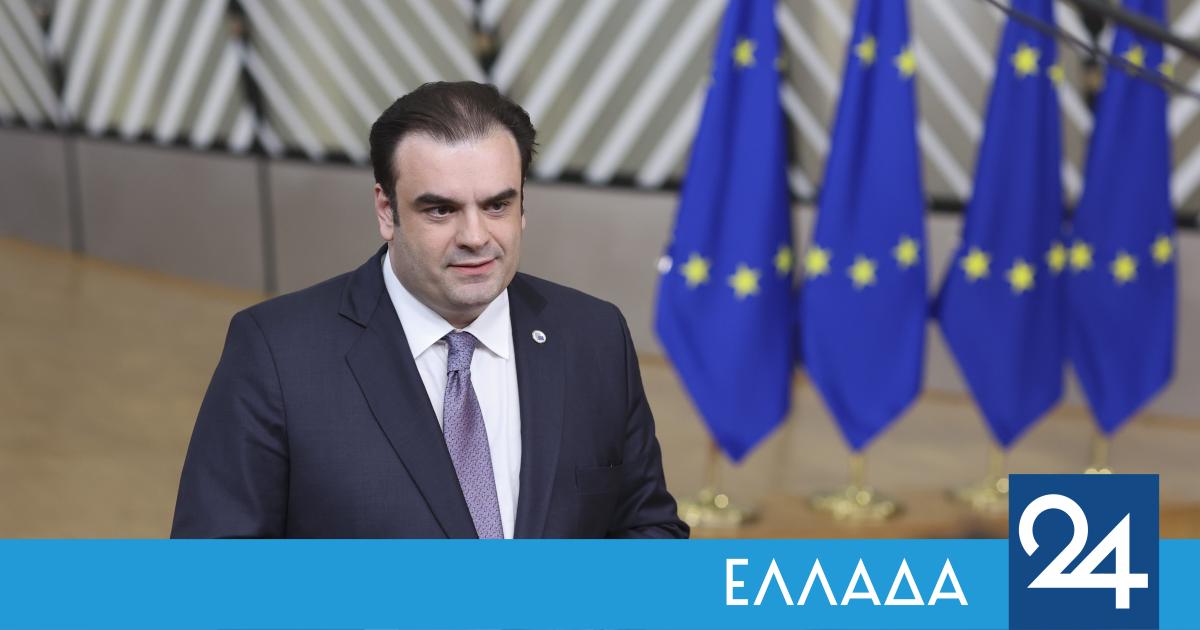
In a speech at a meeting with EU Heads of Diplomatic Missions at the Embassy of the Republic of Cyprus in Athens, Kyriakos Pierrakakis, Minister of Economy and Finance and President of the Eurogroup, expressed his confidence that the primary surplus will exceed the target.
And he pointed out that “this creates, always in the context of the new financial rules of the European Union, additional budgetary space, which we intend to direct towards citizens, especially those who are most in need, in a targeted way.”
At the same time, referring to the crisis in the Middle East, the minister said the depth of the crisis in the Strait of Hormuz would depend on three main factors: The first is duration. The first factor is the duration of the crisis. The first factor is the duration of the crisis. The second factor is the level of damage to the energy infrastructure in the region. And the third factor is what the status of the Strait of Hormuz will be after the crisis is over.
The main factor is the extent of the damage to the infrastructure in the Strait of Hormuz.
Adding that due to the crisis, Greece, like all European economies, is expected to see a downward revision of growth forecasts for 2026, as well as an upward revision of inflation estimates.
In detail, the Minister said the following:
“Thank you very much for your kind words and for your kind invitation, Mr. Ambassador. I am very pleased to be with you again in this debate in order to talk openly about issues of common interest in the context of the European Union.
I would like to begin with some introductory remarks on the current situation, both for Greece and at the European level.
In the light of recent geopolitical developments, we have witnessed an extremely dense sequence of events in recent months. This is clearly reflected in the discussions of the Eurogroup and ECOFIN. It often seems as if every month brings a new issue, with its own challenges and risks. To a large extent we are operating in a regime of constant crisis management, which was particularly evident at the recent IMF and World Bank Spring Meetings in Washington, D.C., where many of these issues were discussed at length.
Starting with Greece, I would like to note that tomorrow we will announce the final fiscal outcomes for 2025. All indications are that the performance will be better than expected, with a significantly stronger position, in particular in terms of surplus. This creates, always in the context of the new budgetary rules of the European Union, additional fiscal space, which we intend to direct towards citizens, especially those most in need, in a targeted way. At the same time, this approach also reflects the course of the Greek economy in recent years, which is clearly growth-oriented.
In recent years, the Greek economy has been growing at around twice the European average. We are trying to make up for lost ground after an existential crisis in the previous decade, during which about 25% of GDP was lost. However, in recent years we have achieved sustainable growth rates.
We are, I would say, in a positive feedback loop. We have managed to achieve sustainable fiscal surpluses, the largest and fastest debt reduction in Europe, and at the same time positive growth rates. All this is based on one key condition: stability, both fiscal and political, and, above all, reforms. I would repeat the word ‘reforms’ many times: reforms, reforms, reforms, reforms. It is the only mechanism that can ensure sustainable growth.
It is the only mechanism that can ensure sustainable growth.
At the same time, we are approaching historically low unemployment rates. Provided the current trend continues, we expect to achieve this soon. The banking sector is showing continued improvement, and non-performing loans are declining significantly.
As regards the economic outlook, we expect Greece, as all European economies, to revise downwards its growth forecasts for 2026, and upwards revision of inflation estimates.
This is a consequence of the crisis that we face, particularly with regard to the Strait of Hormuz and the overall crisis in the Middle East. Let me dwell on that a little bit, while moving on to the wider European picture.
The feeling is that the depth of the crisis in the Strait of Hormuz will depend on three key factors:
The first is duration. I would say duration is the key word. How long will the Straits remain in a state of uncertainty or even closed?
The second factor is the level of damage to the region’s energy infrastructure. In the past few weeks, available data recorded some 80 energy facilities experiencing problems, of which 30 are in serious condition.
And the third factor is what the status of the Strait of Hormuz will be after the crisis is over. Because that regime will be valued and integrated into the markets.
These three factors, taken together, determine the range of possible outcomes of the current crisis in the Middle East.
I would add that we should be fully aware that policies adopted in times of crisis tend to have a duration in time. If you look back to the 1970s and the energy crisis of that time, you will see a range of consequences, some positive, some negative.
For example, the International Energy Agency (IEA) was established then, which today proves to be extremely important. The existence of the IEA plays a crucial role in managing the current crisis. Even the recent possibility of releasing 400 million barrels from strategic reserves was a particularly important intervention.
After the crisis of the 1970s there was also a shift towards nuclear power. About 40% of total installed capacity was developed after the oil crisis. The same period saw a significant increase in interest in the energy resources of the Soviet Union, now Russia, and an acceleration in the exploitation of the oil fields in the North Sea.
I mention these examples to emphasise that decisions taken in times of crisis can have effects that last for decades. For this reason, it is crucial today to be aware that every decision we take, either as Member States or collectively as Europe, can have significant consequences, which are not always predictable.
We often have a tendency to over-rationalise the past, dramatise the present and underestimate the future. And at this juncture, we should not underestimate the future.
At the European level, we are obviously discussing policies that can best respond to the concerns of citizens and businesses. The policy framework that has been developed emphasises temporary, targeted and tailored measures.
And the measures we have taken at the national level, which we announced a few weeks ago, follow this logic. Let me mention one of them by way of example: the Fuel Pass, an energy allowance aimed at easing the burden on citizens most affected by the crisis.
At the same time, the European Commission is developing and presenting a policy framework that acts as a guideline for Member States to enable them to respond effectively to the needs of citizens and businesses. Obviously, the evolution of the interventions will largely depend on how the situation develops in the coming period.
I would like to conclude by highlighting another crucial factor: fiscal and monetary policy must move in coordination. No fiscal measures should be taken that contradict the monetary policy that the European Central Bank is independently pursuing.
Indeed, we should avoid the energy crisis turning into a fiscal crisis. This means that our interventions must be fully targeted, “surgical”, and within the policy framework formulated by the European Commission.
In closing on this point, and also in response to your question, Mr. Ambassador, let me say that this was the main theme that also dominated the week of the IMF meeting. This is, without a doubt, a very big crisis. None of us wish, nor do I think it is likely, that the worst-case scenario will prevail. However, if we consider the possibilities, it is worth repeating something I have already said publicly, quoting the words of Fatih Birol, Executive Director of the International Energy Agency: this crisis has the potential to prove more serious than the three previous energy crises combined.
If you look at the losses in terms of millions of barrels per day in 1973 and 1979, the total was about 10 million barrels per day. Today we are at levels of minus 13 million barrels. Similarly, in natural gas, compared to 2022, the annual production loss, if we approximate it on an annual basis, is higher today. Back then we had a reduction of about 75 bcm (from 155 to 80), while today the estimate is 110.
Obviously, the energy resources passing through the Strait of Hormuz are mainly directed to Asia, both in terms of gas and oil. However, the impact of the crisis is global. And it is not just limited to oil and gas, but extends to fertilisers, petrochemicals and even to the sun. It is a crisis with broader, systemic dimensions.
It is a crisis with broader, systemic dimensions.
Ideally, it must end as soon as possible. And that is why, as I mentioned, duration is the key word. That was our main point of concern.
Let me add one more issue before I move on to more strictly European policy issues: artificial intelligence.
Have you seen the recent developments, with progress being made in increasingly powerful AI models and large language models. Globally, and certainly in Europe, a serious debate on AI governance has already started. This is an issue that I intend to raise at the Eurogroup as well.
Given my personal background in the digital sector, there is a clear conviction that AI governance cannot be exclusively national, neither American, nor Chinese, nor even European in itself. A global approach is required.
The issue is extremely large. The development and widespread use of such algorithms can have a huge impact, and so we need to develop the right institutional tools to be able to manage the situation effectively.
The speed at which AI models are evolving is exponential, to the extent that it is often difficult to even fully comprehend. The human mind perceives the world linearly, whereas the evolution here is exponential. At the same time, political systems and political reactions tend to move at “sub-linear” rates, not even linear.
‘So, we need to be able to move with great speed in an area whose implications we do not yet fully understand.
Last point: what should be the European response to these challenges?
To a large extent, these are issues that were also raised in the discussions between European ministers in the context of the IMF meetings. We need to further strengthen our “economic architecture”, to strengthen our common edifice, even more and even better.
In the context of the talks at the European Council in Brussels, we need to further strengthen our “economic architecture”, to strengthen our common edifice even more and even better.
The Savings and Investment Union is the great policy project of our generation. It is a complex project, difficult to communicate, as it involves multiple subfields: the integration and strengthening of the banking sector, the removal of barriers between European capital markets, the integration of stock markets, and much more.
The opportunity cost of not implementing SIU is huge. And it is huge for each individual country. At the European level, we all agree in principle with this direction, but we often accompany our position with “national asterisks”. However, this attitude now seems to be gradually receding. There is a growing understanding that the cost of inaction is too high.
The Draghi and Letta reports clearly capture this cost. The IMF estimates that the level of GDP in Europe could be 5% to 7% higher with full implementation of the SIU. This would be reflected in each country’s growth, job creation and wage levels.
The effect would be horizontal, across the entire European economy.
And to have real influence in debates like the ones we have mentioned, whether it is the energy crisis of this period or the governance of AI, we are all stronger when we act as one.
We need a truly single market so that we can harness the size and momentum of an economic superpower in these discussions.
We are moving forward, and this is the framework of the mandate that we as finance ministers have received from leaders, to take forward the implementation of the SIU. It is not a single measure, but a set of policy interventions, as I have already mentioned.
The Cyprus Presidency has accelerated this debate and, as far as I know, the Irish Presidency will continue in the same direction. We have to move to tight timetables to meet the expectations of the leaders. However, I am optimistic that we will succeed.
I would also like to mention the digital euro, which is a particularly important issue currently being discussed at European level, with a horizon of 2029.
The United States has not chosen to develop a digital dollar, putting more emphasis on private innovation in the financial system, particularly in stablecoins. The US already has a relevant regulatory framework, the so-called Genius Act, which acts as a counterpart to the European MiCA regulation. Similarly, in Europe we are allowing private innovation in the financial system. However, the core of our strategy is the digital euro.
We need to move faster because technological development in the financial system is equally intense and exponential. Every month of delay counts. We need to strengthen the euro’s footprint internationally. Eurozone countries recognise the need to strengthen the international presence of the currency, and the key tool to achieve this is the digital euro.
To sum up, these are the main issues we discussed, both in the context of the IMF and World Bank meetings and in the context of the European institutions.”
</html