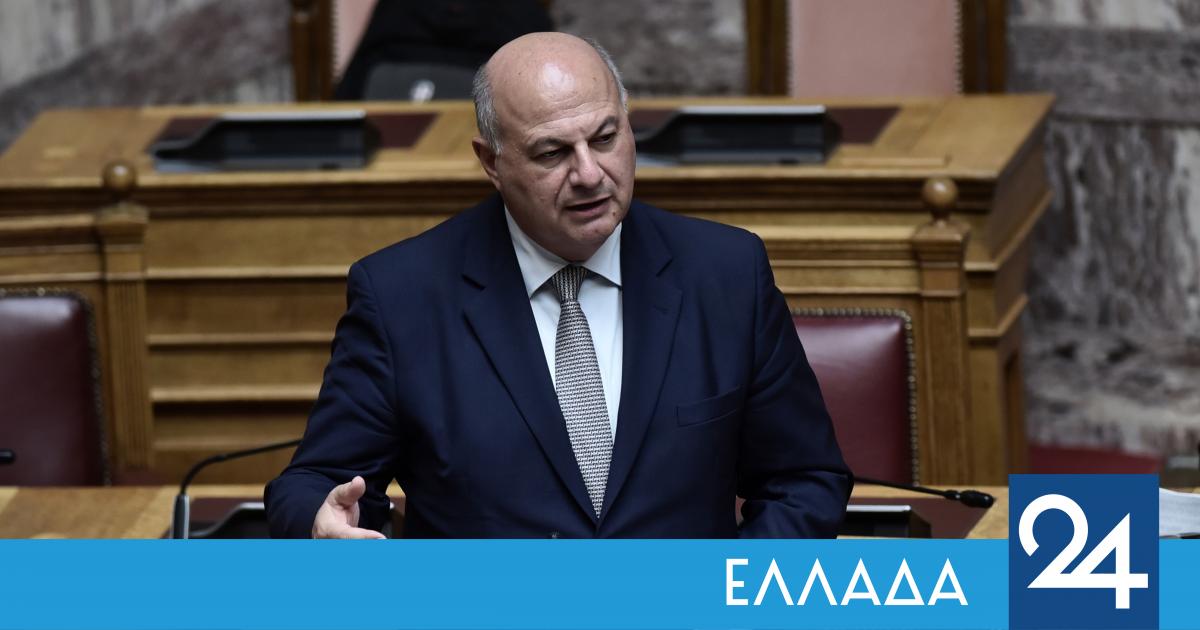
The decisive role of knowledge, education and innovation for the future of the primary sector in Greece was underlined by the Minister of Rural Development and Food, Kostas Tsiaras, in his speech at the 11th Panhellenic Conference of the Department of Agriculture of the Aristotle University of Thessaloniki, entitled “From the Seed of Knowledge to the Fruit of Innovation – 100 Years of the Department of Agriculture of the Aristotle University of Thessaloniki”. The event took place in the framework of Agrotica 2026 (12-15/3) and was dedicated to the 100th anniversary, in 2027, of the establishment of the Faculty of Agriculture of the Aristotle University of Thessaloniki.
Describing the completion of 99 years of operation of the School as a “special moment for the academic and agricultural community of the country”, Mr. Tsiaras noted that generations of scientists have passed through the lecture halls and laboratories of the institution who have contributed decisively to the modernization of Greek agriculture and the support of the Greek producer. “Almost a century ago, a seed of knowledge was planted that nourished Greek agriculture with scientific thinking, research and human potential,” he noted, stressing that, today, the results of this course are evident in the economy, society and science of the country.
Agriculture in transformation – Knowledge “key” for growth
Agriculture is currently at the centre of major transformations, Mr. Tsiaras, explaining that the climate crisis, pressures on natural resources, rapid technological developments and new consumer demands are radically changing the production model. At the same time, international instability is affecting agricultural markets and creating a new, more challenging environment for the primary sector.
In this context, he stressed that knowledge is a key prerequisite for both the survival and growth of the primary sector. However, he noted that Greece still lags behind the European average in the field of agricultural education and training, as the percentage of farmers with systematic agricultural education remains lower than in many EU countries.
He made particular reference to the AKIS (Agricultural Knowledge and Innovation System), which, as he explained, creates a dynamic network of cooperation between universities, researchers, agronomic consultants, farmers, agri-food businesses and public administration, with the aim of disseminating knowledge and applying innovation to production.
Among other things, Mr. Tsiaras said that the stake of the next hundred years is a more competitive, sustainable and resilient Greek agriculture, with more knowledge, more cooperation and more opportunities for the new generation of scientists and producers.
Greetings
Nikos Papaioannou, Deputy Minister of Education, Religious Affairs and Sports, responsible for Higher Education, referred to the importance of linking university knowledge with innovation and the real economy.
Mr. Papaioannou described the Department of Agriculture as a “jewel” for the Aristotle University of Thessaloniki, underlining its strong interdisciplinarity, as it covers a wide range of subjects, from the agri-food chain and the environment to food science.
Expressing his pride as a member of the academic community of the Aristotle University of Thessaloniki, he called on students and researchers to continue with the same extroversion and scientific dynamism, stressing that the Greek farmer needs not only theoretical knowledge, but also its effective connection with practice, for the benefit of the primary sector and the national economy.
The position that the interconnection of knowledge with the market and the economy is not an option, but a necessary condition for survival and growth, was expressed by the Deputy Minister of Development, responsible for Research and Innovation, Stavros Kalafatis, who stressed the importance of innovation, new knowledge and the connection of research with the economy.
He said that innovation and new technologies, led by artificial intelligence, are shaping a new era that will have a decisive impact on all sectors of the economy, including the agri-food sector. At the same time, he referred to the reform for the creation of a Ministry of Higher Education, Research and Innovation, which aims to link scientific research more closely to the needs of the economy and society. Among other things, he pointed out that the government is investing significant resources in the country’s research infrastructure, stressing that the agri-food sector can be a key pillar of development in the coming years.
The President of ELGO-DIMITRA, Spyros Mamalis, pointed to the confusion that new technologies and innovations often cause to producers when they are not accompanied by proper planning and training.
He said that many of the innovations introduced in agricultural production do not always meet the real needs of producers, resulting in a disconnect between research and the production process. This, he noted, can even lead to wrong policy directions, especially in areas such as digital agriculture.
In this context, he stressed that targeted policy and technical interventions are needed, which are already being planned in cooperation with the Ministry of Rural Development. Among the key priorities he mentioned are strengthening cooperation between research institutions, businesses and society, upgrading farmers’ skills in the new digital era, strengthening rural entrepreneurship, consumer protection and sustainable development of the agri-food sector.
Geopolitical instability, economic uncertainty and the climate crisis make it more necessary than ever to create a robust knowledge and innovation base, said the President of the Geotech – Central Macedonia Department, Athanasios Saropoulos.
He explained that Geotech has set up eight working groups with 75 experts, which are producing innovative findings on the adaptation of agriculture, livestock and beekeeping, as well as on the management of natural disasters, forests and water. He said that this is a unique project in Greece, which should be exploited immediately. With proper funding and modern organization, this knowledge can reach the producers and become a tool for sustainable development, enhancing the progress and resilience of the agricultural sector.
The Dean and Professor of Cardiovascular Surgery, Kyriakos Anastasiades, welcoming the participants, made special reference to the importance of the Department of Agriculture, which for almost a century has been sowing knowledge and transforming research into innovation with a tangible impact on society and primary production. He underlined the strategic cooperation of the Aristotle University of Thessaloniki with the Faculty of Agriculture, noting that it is a model of extroversion, and pointed out that scientific knowledge is not limited to the lecture halls, but is directly linked to production, entrepreneurship and people.
Among other things, he said that digital agriculture, biotechnology and value-added agri-food products are key pillars of the department, while the active connection of students with the labour market ensures that graduates turn knowledge into growth, enhancing the sustainability and resilience of the Greek region.
The President of TIF-Helexpo, Christos Tsentemeidis, in his welcome address – among other things – stressed that the cooperation between the two institutions connects academic knowledge with the real economy and underlined the international dynamics of the exhibition, with 1.500 exhibitors from 42 countries and a significant increase in foreign participation.
The conference is co-organised by TIF-Helexpo and the Department of Agriculture of the Aristotle University of Thessaloniki and will conclude its work tomorrow.