Cruising is entering a slowdown trajectory for 2026, with geopolitical instability accelerating this trend that was already evident before the Middle East crisis erupted.
The international market is rearranging, flows are changing and Greece is being asked to balance between losses and new opportunities in a more nervous and decidedly more unpredictable environment.
The latest estimates show a clear downturn in both ship arrivals and passengers, reversing the industry’s multi-year upward trend.
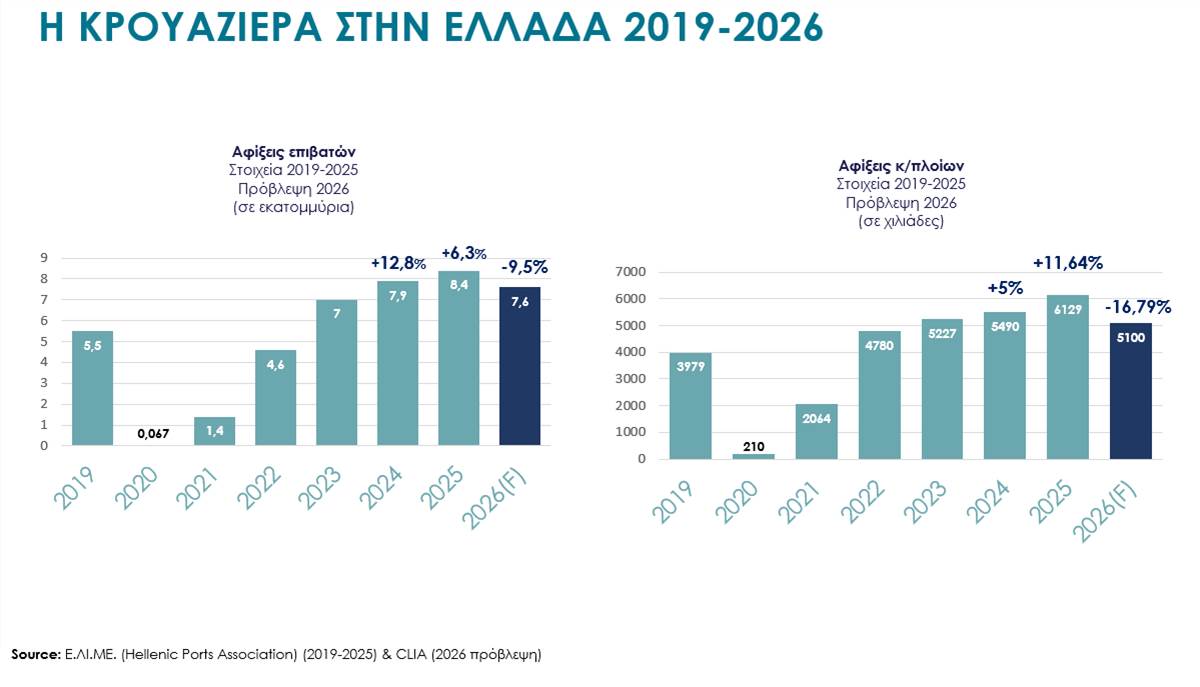
According to Cruise Lines International Association (CLIA) data on 15 February, even before the geopolitical crisis erupted, there was an estimated 16.7% decline in cruise ship calls and 9.5% decline in passengers in our country, confirming that the market is entering a “correction” phase after years of strong post-pandemic growth.
This slowdown is not one-dimensional. Market players point out that, in addition to cyclical factors, structural factors such as the cruise fee are also playing a role.
In particularly popular destinations, such as Mykonos and Santorini, the fee reaches 20 euros per passenger, adding to overall costs and affecting competitiveness.
At the same time, the realignment of the international market also creates new opportunities for Greece.
The shift of activity from the Middle East, due to increased geopolitical risk, is leading companies to reschedule routes, reinforcing the importance of the Mediterranean. In this context, Greece is attempting to absorb some of the activity moving away from war zones.
The role of the port of Piraeus, which is emerging as a key cruise hub, remains crucial.
As noted by CLIA’s Eastern Mediterranean Director, Maria Deligianni, speaking at an event organised by the Municipality of Piraeus, the port is ranked 13th worldwide in terms of home porting, with a rate of 80%, and is a critical point for crew changes.
A total of 6,129 arrivals and 8.4 million passenger arrivals were recorded, with Piraeus maintaining the lead (863 arrivals and 1.85 million passengers)
Mykonos and Santorini followed, while Corfu, Rhodes and Heraklion were also in the top ten, confirming the dispersion of demand across the country.
However, 2026 starts on distinctly different terms. Tension in the Middle East, uncertainty over maritime security and the stranding of ships in the region create a high-risk environment.
As the honorary president of the Greek Cruise Shipowners & Shipping Operators Association (EEKFN), Theodoros Kontes, points out, the key scenario is no longer growth but the maintenance of 2025 levels.
Kontes also stresses that the attitude of key markets is of particular concern. He says that Americans – who are the largest pool of passengers with almost 2.9 million arrivals – appear more cautious, while Israelis are cutting back significantly on travel.
At the same time, bookings are hovering at low levels, with tourists taking a wait-and-see attitude and the increased cost of travel acting as a deterrent.
However, despite the unfavorable environment, some opportunities are emerging. Greece is still considered a safe destination and can absorb some of the demand from regions such as Israel, Egypt and Turkey, while increased mobility is expected in the Ionian and Adriatic.
Already, MSC Cruises is adjusting its planning, while Explora Journeys is revising its schedule, moving itineraries from the Middle East to the Mediterranean, with Greece among the benefiting destinations.
The baseline scenario, however, remains fragile. As Condes notes, initial estimates of a 4%-5% increase have effectively been cancelled and even maintaining 2025 levels is now considered optimistic.
He notes that the year’s performance will largely depend on the duration of the crisis and the restoration of safety in shipping.
In any case, however, 2026 is shaping up to be a year of endurance for the cruise industry, with the industry being called upon to adapt to a new, more volatile international environment, where flexibility and speed of adaptation will determine the winners of the next day.