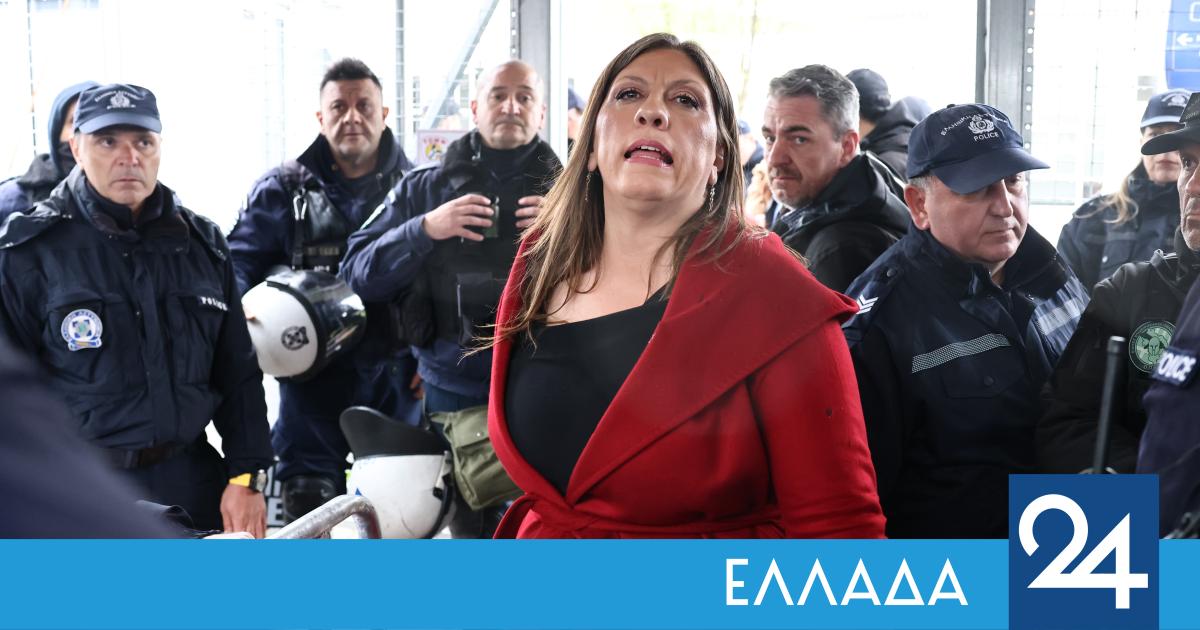
The Union of Greek Prosecutors has issued a statement against Zoe Konstantopoulou, but without naming her.
The Union of Public Prosecutors refers to the two trials on the tragedy of Tempi, stressing that “the ‘wise’ silence that will allow all the players in the trial – prosecutors and judicial officials, lawyers and litigants – to participate in it, faithfully observing the procedural rules established by the state, is disturbed by shouts. Cries that are inarticulate, uninspired and unworthy of serious judicial assessment, coming even from a lawyer representing relatives of the victims of the accident, who have the immense understanding and sympathy of the entire Greek people”.
The statement of the Union of Greek Prosecutors:
The Union of Greek Prosecutors, representing the more than six hundred prosecutors of the country, has chosen to date to follow the path of serious, sober and absolutely procedural reason in its public statements on what has been happening lately, regarding the main trial for the Tempi accident, but also the trial regarding the video footage of the commercial train involved in the accident. Having a deep conviction that the time of the trial of any case is the culminating moment when the highest of virtues, Justice, is transformed into action, we insisted on our position for peace and the prevalence of a climate of reconciliation, and we continue to believe firmly in the saying of the ancient tragedian Euripides that “silence is the answer to the wise”.
But unfortunately, this “wise” silence, which will allow all the players in the trial – prosecutors and judges, lawyers and litigants – to participate in it, in strict compliance with the procedural rules established by the state, is being disturbed by shouting. Cries that are inarticulate, uninspired and unworthy of serious judicial consideration, coming even from a lawyer representing relatives of the victims of the accident, who have the immense understanding and sympathy of the entire Greek people. A lawyer who, under the cloak of her parliamentary immunity, has been guilty of ugliness and malpractice in every appearance before the court, with the only consequence of what she claims she does not want, namely the non-trial. Her constant attacks on members of the judiciary constitute not only a brutal insult to their judicial capacity, but also a direct affront to their physical and mental health. Forcing a Judge by force and mercilessly beating up the same person to refrain from hearing a case has not been seen even in legally unstable countries and will be the blackest page in the judicial annals of the world.
And in the face of such conduct, an unacceptable deafening to even disrespectful silence from those who by law have the right, as co-operators of justice, and the obligation to discipline, to control the systematic violation of every rule of legal ethics, but also to isolate and condemn it, when such behaviour is manifested before the representatives of the Athens Bar Association and the Plenary of the Bar Associations, who are performing their sacred duty of supporting the prosecution, but above all of empowering the victims’ relatives to ensure that they are not walking alone on the difficult path of their grief. The same concerns are also caused by the silence of the Greek legal community in the face of this holy event, even though the basic principles of the modern state, which are the conquest of centuries, are being shaken to the core.
We again emphatically stress that the protection of Justice, as the cornerstone of the rule of law and democracy, is a collective responsibility and cannot be compromised by individual and utterly reprehensible behaviour. Greek citizens must be assured that all trials related to the Tempi accident will be conducted in accordance with the rules prescribed by the Constitution and the law, and not according to selfish expediency, wherever it may come from.
The Hellenic Union of Public Prosecutors remains by the side of its members, strengthening them both in their institutional role, which they perform with a high sense of responsibility and self-denial, even under the above difficult and institutionally unacceptable conditions, and on a personal level, given that behind their institutional face, they remain people with dignity and limits.