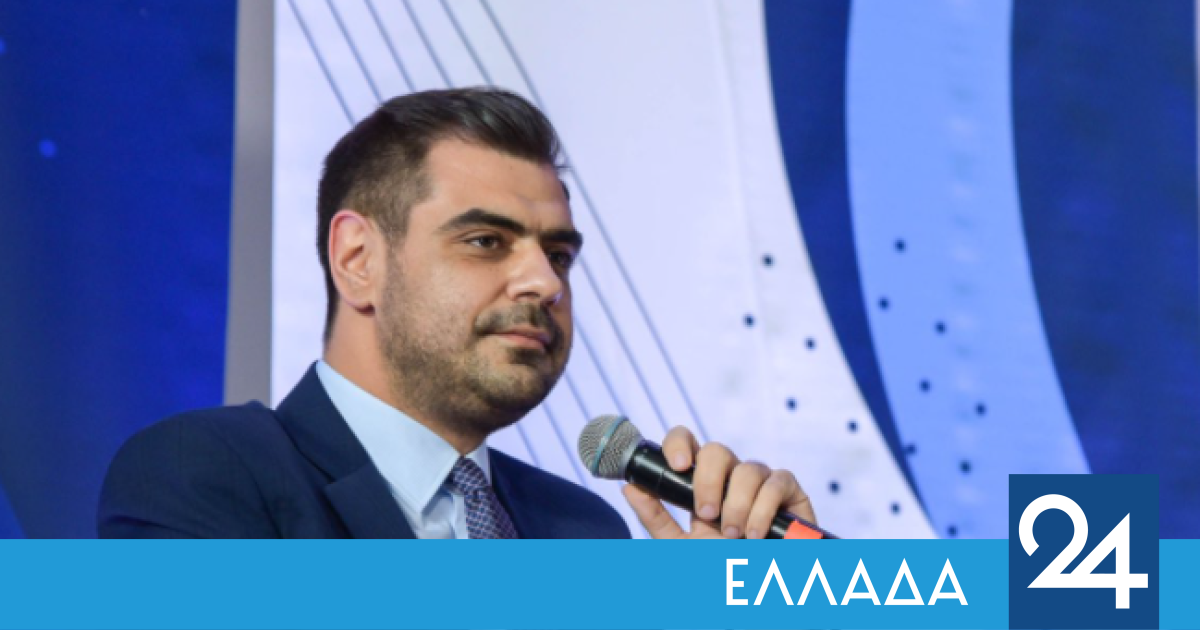
The public debate on the country’s course, political stability and the functioning of the institutions was the focus of an interview with Deputy Prime Minister and government spokesman Pavlos Marinakis on SKAI 100.3. At the core of the government’s arguments is the need for consistency in the face of the popular mandate of 2023, which – as underlined – does not only concern the completion of the four-year term, but also the full implementation of the governance program, with recognition and correction of mistakes. Particular emphasis is placed on maintaining political stability, which is presented as a crucial achievement after a long period of crises and uncertainty. The country’s economic performance, the strengthening of its international position and initiatives in foreign policy and defence are presented as indicative of an overall improvement, which should not be jeopardised by premature electoral choices.
“We have taken a decision, then, unlike what may have happened in other periods of the post-independence period, to fully respect the mandate of the Greek citizens, which is not only about duration, i.e. to exhaust the four-year term, it is also about implementing the programme, correcting mistakes, admitting mistakes and, at the end of the day, being judged – both ours and others’ – by the citizens. So that is what I am making clear. And you know, the reason why this decision of the Prime Minister is clear and does not change is because for Kyriakos Mitsotakis it is an identity issue. That is, we cannot talk about anything else if we deviate in the tautonic issues, that is, DNA issues, which are of a DNA logic.
.
There is a second reason why I think a contrary decision would be very – the lenient I might say – irresponsible. We have managed, with the result of the elections, with the stabilisation of the economy, with the fact that in addition to stabilisation, our economy has managed to have higher revenues and lower tax rates, something that even in the recent budget the opposition, including PASOK, accused us of, even in the recent budget, we have a clear change in the image of Greece abroad, in terms of foreign policy, in terms of defence, the agreements we have with Italy, with Egypt, the expansion in the Ionian Sea, with everything we have done, the maritime spatial planning, all these are conquests after many sacrifices of citizens, after mistakes that were corrected, after difficult times we have gone through and what is required in crises for other countries, so that we can go through a crisis together and support society, some people are asking us to cede it”, Mr. Marinakis, stressing that “the elections will be held in 2027.”
The upcoming pre-daily debate in Parliament on the issue of wiretapping is still being finalized, and as Marinakis said, the government will take an institutional position on the opposition’s proposals. He stressed that this is a serious case, which has already occupied the judiciary in recent years, without underestimating its importance. He recalled that from the very first moment political responsibilities had been assumed, there had been resignations and legislative interventions had been promoted to tighten up the framework for interception and illegal software, initiatives which had been recognised at European level. At the same time, he pointed out that the judiciary had already examined the case at the highest level, concluding that no responsibility of state officials had been established, while private individuals had been indicted, convicted at first instance and appealed. He refrained from commenting further, stressing that he could not prejudge judicial developments or substitute the courts, especially in view of the second instance trial and possible new investigations.
With regard to the illegal software, he said that the relevant evidence has already been brought to the attention of the judiciary and has been evaluated, and stressed that there is no knowledge of any involvement of the NIS. Furthermore, he underlined the distinction between evidence and proven responsibility, stressing the importance of judicial decisions. He also rejected the linking of the case with early election scenarios, arguing that such discussions are part of a broader political tactic of instrumentalising individual issues by the opposition in order to cover up the lack of programmatic discourse. He reiterated that the elections would be held normally in the scheduled time and that the citizens would judge the overall work of the government.
As for the PASOK congress, he criticised the party for not giving clear answers on possible government partners and programmatic positions, despite its ambition to be a party of power. Moreover, he pointed out that the strong rhetoric about “clean hands” and the rule of law appears contradictory to the party’s past, without this implying collective responsibility for its members. On the rule of law, he raised the picture recorded by European Commission reports, according to which Greece shows improvement and fewer recommendations than other member states, particularly in the area of press freedom.
He also referred to statements made by former political figures, stressing that their criticism should take into account past experience. Regarding the electoral law, he pointed out that the current government has introduced a stricter system than those in force in the past and that the main objective remains self-reliance in order to ensure stable governance. However, in the event that this is not achieved, he said that a government should be sought to be formed, with PASOK as the only possible interlocutor due to its previous governmental experience, although the party itself appears to reject this prospect. Overall, he put forward the position that the country needs stability and clear political choices, with the final judgment resting with the people.
About the electoral law, he said that “I recall that all the previous Prime Ministers, from ’93 onwards, all the predecessors of Kyriakos Mitsotakis, were elected specifically by the law of the former President of the Republic, Mr. Pavlopoulos and afterwards, with the 50-seat bonus. Mr. Tsipras invented the simple proportional representation when he saw that he could not be re-elected Prime Minister. Now that is what has happened, that is the electoral law, it does not change. So we are the government that voted for itself, probably for itself, because it seemed that we re-elected a stricter electoral law than the law under which we were elected and inherited. That’s the first one. Now, look, I’ve heard the 40% theory, I don’t want to go to 35%, 40%, 45%. I think that from the PASOK conference on the one hand, and from the position that we have articulated with the Prime Minister first on the other hand, there is a very big contrast, a very big contrast emerging. First of all, we too have not said “let’s come together in government” in PASOK. And I don’t think that even when you have the first and the second party in the political system, the government and the opposition, it is not healthy for either one or the other to go into coalition. If there is no opposition, if there is no fierce political conflict, but only to the point of political conflict, not as it happened 10 years ago, then you do not have a healthy political system. But what are we saying? Our position is clearly different. We are clearly calling for self-reliance for political reasons, for reasons of policy implementation in the economy, in foreign policy, in everything. In any case. Let’s not bore people. But if the people decide otherwise, that is, if they don’t give us the percentage that gives us self-reliance, we should seek the country the next day to have a government.”
The focus then turned to issues of institutional justice, political debate and the economy. Regarding the second OPEKEPE file, it was stressed that so far there is no official information and rumours cannot be commented on, while it was underlined that any evidence that will emerge from the judiciary will be evaluated by all political forces. Regarding the Monument of the Unknown Soldier, Mr. Marinakis pointed out that it has a specific symbolism for the fallen of the homeland and it is proposed to create a separate monument for the victims of Tempi, without this constituting disrespect, but on the contrary a distinct respect in each case.
On the Tempi trial, he noted that “several, many meetings were held both at the operational and political level with the relevant ministries, the Ministry of Justice and the Ministry of Citizen Protection. There is a clear instruction and agreement between the court, the judges, the prosecutor and the Greek Police and even experienced representatives of the Greek Police will be there, so that the accused, 36 if they are all, I remind you that 36 people are on trial, 33 of them for a felony. The advocates, where there are 250 seats and if they come and all those who are legal will be able to exercise their duties automatically and the litigants, that is the relatives, all these seats are for these people and there is everything else in the courtroom for the journalists and for the public. It was a bad picture that was created, not because the room was small, but because there was no organizational care taken to have reserved seats for the people who are involved in the trial, that is, the relatives, the lawyers and the defendants.”
He stressed the need to respect justice and avoid political interference or “instrumentalisation” of the process. At the same time, he criticised political attitudes that, in the government’s view, undermine institutions, with points mainly directed at the opposition.
On statements by former Prime Minister Antonis Samaras, he avoided direct comment, but stressed that foreign policy is judged by actions, projecting government actions on the diplomatic and defense level as strengthening the country. Finally, on the economy, he argued that the state of purchasing power is gradually improving, with wage growth, tax cuts and job creation, rejecting the claim that Greece is at the bottom of the European league table, while calling on the opposition to substantiate its proposals on public revenues and tax policy.