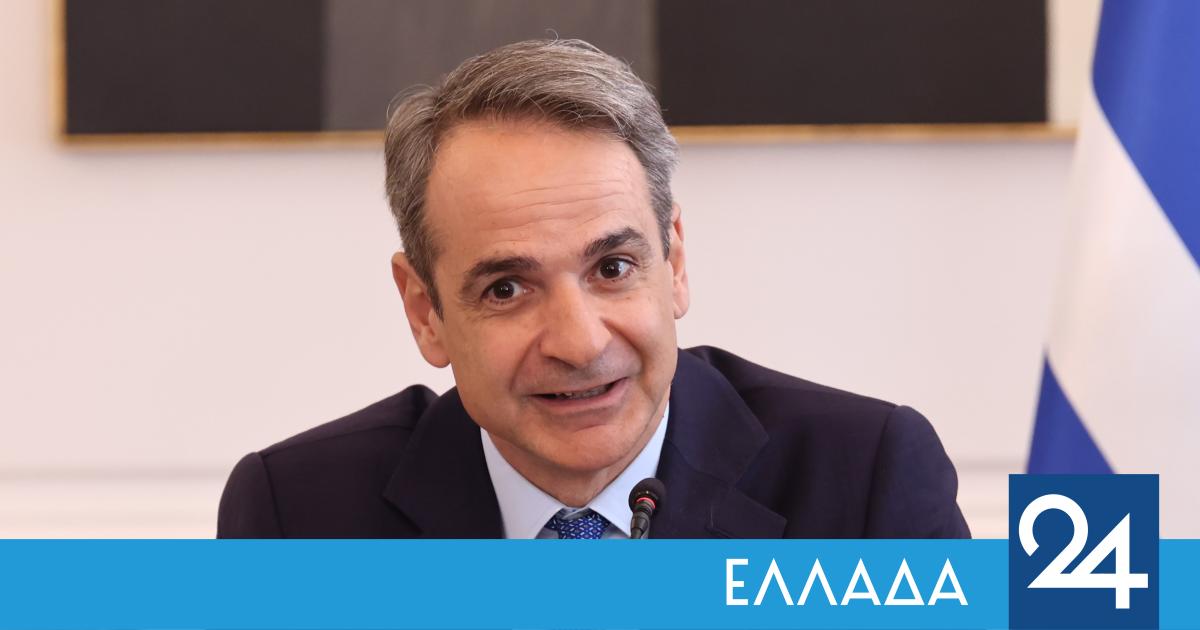
Prime Minister Kyriakos Mitsotakis chaired a meeting on the establishment of the Higher School of Performing Arts (ASPT) at the Maximos Mansion. The establishment of the ASPT was legislated last week and is the first public Higher Educational Institution to be created in Greece for the teaching of drama, orchestral and musical arts.
During the meeting, it was noted that the establishment of the ASPT and the overall reform of arts education put, for the first time, clear rules in a field that had been operating for decades with institutional ambiguities regarding the classification of studies, their academic continuity and the status of qualifications in the public sector.
Prime Minister Kyriakos Mitsotakis said at the opening of the meeting:
“We are pleased to be in the position, something that was a commitment of ours, to be able to implement it now. I remember from when I was a pioneer in politics that this discussion about an arts education was taking place, which was basically operating without any institutional framework, with thousands of young people investing time, effort and talent in theatre, dance and music and not getting the recognition they deserved. I think that this is finally changing. With this Higher School of Performing Arts, the performing arts are for the first time acquiring what has always been the goal: a serious university status, with studies, with the possibility of research and, above all, with prospects for development.”
It should be noted that starting from the 2027-28 academic year, the ASPT will be able to enrol students and provide a full academic pathway, from undergraduate to doctoral level, giving institutionalisation and university status to artistic studies.
The new law also resolves the long-standing pending issue of the unclear link between artistic studies and professional rights in the public sector, through the creation of a new category of public sector personnel entitled “Artistic Education” for employees who either perform artistic work or serve as teachers in the arts.
Mitsotakis noted that the government is responding with actions to a decades-old demand, adding:
“It is a reform of substance, not a reform of impressions. I think that here we are essentially drawing a line with the past, we are resolving outstanding issues from the past, but above all we are giving a perspective to young children, who are interested in culture, in the performing arts, to have a clear vision of how they will move, what their professional path will be, what their qualifications will be, what the value of the degree they will get from a Greek university will be.”
Close cooperation with the art world*
As part of the reform, the accumulated experience and knowledge in arts education is being put to good use, as departments of the five historic public institutions in the field will operate under the university roof of the new university: the Department of Dramatic Art of the National Theatre, the Department of Orchestral Art of the National Opera, the Department of Orchestral Art of the State School of Orchestral Art, the Department of Dramatic Art of the State Theatre of Northern Greece and the Department of Music Art of the State Conservatory of Thessaloniki.
In addition to the connection with the arts and its historical institutions, the new School will also preserve the specificities of teaching the arts compared to other fields of knowledge, through functional provisions provided by the law, which emerged from a two-year consultation with representatives of the artistic world.
For this reason, admission to APST departments will be through special examinations, which include a compulsory hearing of candidates for their live assessment. The selection of Special Artistic Staff will be based primarily on the work of the artistic personalities who will take up the positions, recognizing their prestige. In addition, the new institution will have a 9-member Artistic Council that will provide unpaid advisory services, five members of which will be nominated by the five historical bodies of artistic education.
Particular emphasis was placed on the next steps for the rapid formation of the transitional Steering Committee of the new HEI and the preparation for the preparation of the curricula. From all sides, the importance of good cooperation and understanding between the government and the art world was stressed, which was reflected in the legislation for the establishment of the ASPT.
During the discussion, the importance of creative activities in the lives of minors, especially at younger ages, was also highlighted. “We are now having a very big discussion about the problems of our children and teenagers, the dependence on social media, the addictive behaviours that, unfortunately, all these algorithms consciously promote and I was thinking that, ultimately, the answer, especially for younger children, cannot be other than sports and art,” the Prime Minister noted.
“That is why I think that we will have to – we have discussed this with the Minister – and we will need your help both as persons and, now and tomorrow, as a Higher School, how we will revisit art and music education,” Kyriakos Mitsotakis added. “We should at least know that there are some answers, which are linked to timeless human nature, which especially at this juncture we have one more reason to support.”
For her part, Minister of Education, Religious Affairs and Sports Sofia Zacharaki said that the establishment of the Higher School of Performing Arts is indeed a historic breakthrough for arts education in our country “and now we are going through the legislation, which brought us great joy, as you have seen, we had broad parliamentary support and this made us very happy and now from the legislation we are moving on to the implementation and establishment. So, to prioritisation. The priority for the new school is to quickly acquire the administrative base, academic identity, modern curricula and a solid interface with the historical institutions of the area.”
Referring to the meeting with Kyriakos Mitsotakis, she said that “with the Prime Minister we will formulate a clear road map, specific steps for the formation of the Board and the next steps, so that the reform can proceed with a plan, seriousness and see in 2027 the beginning of the operation of the School and the first admissions with special examinations, as we are talking about a distinct and separate process, which I must tell you that we surround with great care and great respect.”
*For her part, Culture Minister Lina Mendoni noted:
“The establishment of the Higher School of Performing Arts is a major reform in the cultural life of our country. A country that has a very strong and international footprint in contemporary creation and which until the day before yesterday – literally the day before yesterday – did not have the stable, public, institutional body to recognize this reality.
So your government, and by your own personal will, has turned a decades-old vision into a plan and the plan into a reality.”
Deputy Minister of Education responsible for higher education Nikos Papaioannou said, among other things:
“What matters to me right now is to put the roadmap of turning the law into action. That is, to talk about the administrative organisation with the interim Steering Committee, then talk about the academic organisation, the institutional set-up and the academic function. I think that all of us will work together perfectly so that this new university, which has been a decades-long requirement, can actually begin.”
*For his part, Deputy Minister of Culture Iasonas Fotilas said:
“When I was a teenager, I had, timidly, addressed the desire to my father to pursue theatre and acting in my life. He a bit ‘heavy’, grimly told me: “My child, leave the theatre and the arts and go to university.” Thanks to you, from today a child can do both in Greece.
*Representatives of the five historical institutions of arts education stated, among other things, for their part:*
*Chariton Stavropoulos, President of the Greek National Opera*:The National Opera has always considered that the law is in the right direction, that it puts a proper end to all this “anarchy” that has existed in the artistic scene until now. So we have a lot of faith in this bill, we’ll be around, we’ll help as much as we can.
*Giorgos Koumentakis, Artistic Director of the National Opera*:We would like to express our sincere thanks for the, I believe, historic decision you have taken to proceed with the establishment of a Higher School of Performing Arts and its implementation. Of course there are difficulties, but difficulties are there to be solved. Your initiative not only enhances – and I firmly believe this – the prestige of the performing arts, but also safeguards the future of modern culture. With this bill you are offering new generations academic foundations that have not existed until now and the prospects they deserve.
*Ersi Pitta, Vice President of the National Theatre:* Today we can express our satisfaction because all the suggestions we made, concerning specific articles of the bill, were listened to and accepted, so we want to thank the leadership of the Ministries of Culture and Education. We hope that with the establishment of this School, which will ensure the upgrading of studies related to art, this will contribute to art finding the place it deserves, the place it should have, in society.”
*Argyro Chiotis, Artistic Director of the National Theatre:* We have come to talk about this bill, which really defines a new era. For our part, we will be there, step by step, to get through this transitional period and get to where we all want to be.
*Yannoula Karymbali-Tsiptsiou, President of the State Theatre of Northern Greece:* We are very happy because after years of institutional pending, the performing arts finally have a university home, with the establishment of the Higher School of Performing Arts.
*Asterios Peltekis, Artistic Director of the State Theatre of Northern Greece:* This is a very important and important moment. I am very moved because I was here three years ago during the first discussions and I see today that a bill is being completed at a truly outrageous pace for our country, which is very promising and very important, and we thank you very much for your support and immediacy throughout this process. It is a tremendous achievement I think.
I think it is a tremendous achievement.
*Nikos Avdellas: President of the Thessaloniki State Conservatory:* This opportunity that we have had this time to work together and unite all the contemporary art institutions is a great achievement.
*Georgios-Iulios Papadopoulos, Director of the Thessaloniki State Conservatory:* We are grateful for what has happened. We will work with you to put it into practice in the best possible way. We are here to help with all our strengths and support what happened.
*Konstantinos Rigos, President of the State School of Orchestral Art:* A lot of work has been done on the part of the government, the ministers and on the part of the art people. It is important that we are all at the table together and discussing a law that has been passed and is a reality. The next steps are very difficult, very important and must be taken very carefully. For us, the State School of Dance, this is a huge step. It is, truly, an ideal day today.
*Evagelia Kapetanea, Director, State School of Performing Arts:* The establishment of the State School of Performing Arts is a step that the arts community has been waiting for for many years.
The meeting was attended by the Minister of Education, Religious Affairs and Sports Sofia Zacharaki, the Minister of Culture Lina Mendoni, the Deputy Minister responsible for higher education Nikos Papaioannou, Deputy Minister of Culture Iasonas Fotilas, Secretary General of the Prime Minister Stelios Koutnatzis and the Advisor to the Prime Minister on Cultural Affairs Elena Mavromichali.