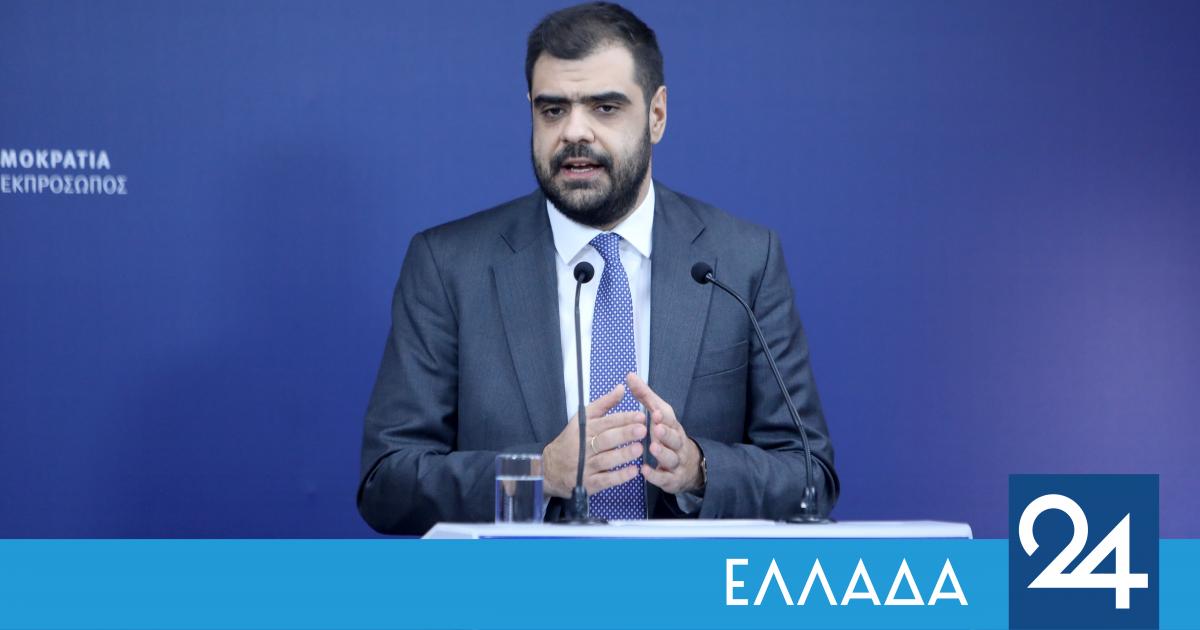
Government spokesman Pavlos Marinakis began his briefing of political editors with a reference to the minimum wage of 920 euros as of Wednesday, April 1. “It is noteworthy that from 2019 the cumulative increase is 41.54% and corresponds to an increase of 270 euros per month or 3,780 euros per year. This is, in essence, 4.2 to 5.8 salaries more. Under this development, Greece now ranks 12th among the 22 countries in the European Union that have a statutory minimum wage,” he said.
“The increase in the minimum wage affects, directly, about 700.700 000 jobs in the private sector, all civil servants, those receiving allowances and benefits calculated on the basis of the minimum wage (i.e.: maternity, parental leave, unemployment) and three-year benefits. At the same time, the average salary is also indirectly affected, which, according to the data of the annual report of the ERGANI system for 2025, amounted to 1,516 euros, up from 1,264 euros in 2019,” he stressed.
He added that this “sixth consecutive increase in the minimum wage, contributes to the expansion of the disposable income of workers, combined with: the significant boost to employment, the extension of the Digital Job Card to 2.000,000+ workers, the new favourable framework for Collective Labour Agreements and the reduction of income tax.”
.
The next item of the briefing was on the positive, preliminary assessment announced by the European Commission on the double payment request submitted by Greece in December 2025, amounting to €1.18 billion. EUR 1.1 billion from the Recovery and Resilience Fund, which related, in total, to 26 milestones and targets. “In particular, the dual request included: the 7th request for grants – for which 22 milestones were met – and the 6th request for Fund loans, for which 4 milestones were met, respectively.
With the green light from the European Commission, the way is clear for the disbursement of the double request. Under these developments, in total, the fulfilled milestones of “Greece 2.0″ amount to 204 and disbursements to €24.58 billion. This means that projects and reforms are being implemented, representing more than 68% of the total budget of the Greek Recovery Fund Plan,”
He also said that additionally “noteworthy is the approval by the Commission of the pioneering NSRF action for affordable and sustainable housing, amounting to about €500 million. Under this, subsidies are provided for the renovation of private, old closed and open housing. This is an initiative that will help address the problem of affordable housing and strengthen social cohesion.”
He went on to say that “the bill of the Ministry of Infrastructure and Transport on the modernisation of the transport operating framework was passed by a majority. Through it, uniform rules are being set in critical areas, from urban transport and the taxi market to technical vehicle inspection, electromobility and sustainable urban mobility, enhancing the safety, transparency and efficiency of the transport system.”
He went on to underline that “according to the Commission’s official road safety data, our country has achieved the second largest reduction in road deaths in 2025, behind Estonia.
In particular, Greece achieved the largest reduction in road deaths in its history, with 517 deaths compared to 665 in 2024, a reduction of 22%, while the European average recorded a reduction of just 3%.
The drastic reduction, in Greece’s case, is the result of a comprehensive road safety strategy implemented by several collaborating ministries and includes: the stricter Road Traffic Code, the intensive and targeted checks by the Greek Police, the use of technology and the development of digital surveillance systems, the strengthening of safe alternatives to travel and targeted measures such as the 24-hour operation of public transport every Saturday night, interventions in infrastructure and the delivery of new, safer roads, such as the Patras-Pyrgos motorway and public awareness campaigns.”
The government spokesman also said that the online submission of applications for inclusion in the NSRF “Produce in Greece” action, worth €50 million, starts tomorrow. The aim is to strengthen the domestic production base in key sectors and to support and expand the export orientation of Greek businesses. Beneficiaries are existing small, micro, small and medium-sized enterprises.
“Among other things, costs are covered for: investments in modern mechanical and production equipment, adoption of advanced technologies, automation and digital systems, obtaining quality certifications, product redesign, design improvement, covering salary costs, etc.etc.,” he added.
“Greece has recorded a significant improvement in the field of Public Integrity, according to a recent OECD report. Specifically, Greece ranks 2nd among all OECD member states and partners in terms of improving its strategic framework for public integrity and anti-corruption. Based on the measurements, Greece recorded the 5th best performance in terms of quality of planning and the 2nd highest rate of implementation of actions.”
He concluded by saying that the Prime Minister is currently chairing a meeting at the Maximou Mansion on the Higher School of Performing Arts.
“The minimum wage will be set at 920 euros from next Wednesday, April 1, from 880 euros, which is currently 880 euros.
It is noteworthy that from 2019, the cumulative increase is 41.54%, corresponding to an increase of 270 euros per month or 3,780 euros per year. This is, in essence, 4.2 to 5.8 salaries more.
.
Under this development, Greece now ranks 12th among the 22 countries in the European Union that apply a statutory minimum wage.
The increase in the minimum wage directly affects around 700.000 jobs in the private sector, all civil servants, those receiving allowances and benefits calculated on the basis of the minimum wage (i.e.: maternity, parental leave, unemployment) and three-year benefits.
In parallel, the average salary is also indirectly affected, which, according to the data of the annual report of the “ERGANI” system for 2025, amounted to 1.516 euros, up from 1,264 euros in 2019.
.
This sixth consecutive increase in the minimum wage contributes to expanding the disposable income of workers, in combination with:
- the significant boost to employment,
- the expansion of the Digital Job Card to more than 2,000,000 workers,
- the reduction of income tax.
The European Commission has announced its positive, preliminary assessment of Greece’s December 2025 double payment request of €1.18 billion. €1.1 billion from the Recovery and Resilience Fund, which covered, in total, 26 milestones and targets.
Specifically, the dual request included: the 7th request for grants – for which 22 milestones were met – and the 6th request for Fund loans, for which 4 milestones were met, respectively.
With the green light from the European Commission, the way is clear for the disbursement of the double request. Under these developments, in total, the fulfilled milestones of “Greece 2.0” amount to 204 and disbursements to €24.58 billion. This means that projects and reforms are being implemented, representing over 68% of the total budget of the Greek Recovery Fund Plan.
.
Additionally, the Commission’s approval of the pioneering NSRF action on affordable and sustainable housing, worth around €500 million, is noteworthy. Under this, subsidies are provided for the renovation of private, old closed and open housing. This is an initiative that will help address the problem of affordable housing and strengthen social cohesion.
The bill of the Ministry of Infrastructure and Transport on the modernisation of the transport operating framework was voted by a majority.
Through this, uniform rules are set in critical areas, from urban transport and the taxi market to technical vehicle inspection, electromobility and sustainable urban mobility, enhancing the safety, transparency and efficiency of the transport system.
Meanwhile, according to official road safety data from the European Commission, our country has achieved the second largest reduction in road deaths in 2025, behind Estonia.
In particular, Greece achieved the largest reduction in road deaths in its history, with 517 deaths compared to 665 in 2024, a reduction of 22%, while the European average recorded a reduction of just 3%.
The drastic reduction, in the case of Greece, is the result of a comprehensive Road Safety Strategy, implemented by several collaborating Ministries, including:
- the stricter Road Traffic Code,
- the intensive and targeted checks by the Greek Police,
- the use of technology and the development of digital surveillance systems
- to strengthen safe travel alternatives and targeted measures such as 24-hour public transport on Saturday nights,
- interventions in infrastructure and the delivery of new, safer roads, such as the Patras-Pyrgos motorway and
- civic awareness campaigns.
The online submission of applications for the NSRF “Produce in Greece” action, worth €50 million, starts tomorrow. The aim is to strengthen the domestic production base in key sectors and to support and expand the export orientation of Greek enterprises.
Beneficiaries are existing small, micro, small and medium-sized enterprises. In particular, applications for business plans with a subsidised budget of between EUR 100 000 and EUR 400 000 are eligible. The grant amounts to between 50% and 55% (with a 5% fast-track bonus) of the eligible budget. The evaluation of funding applications will be comparative.
Among other things, costs are covered for: investments in modern mechanical and production equipment, adoption of advanced technologies, automation and digital systems, obtaining quality certifications, product redesign, design improvements, covering salary costs, etc.etc.
Greece has recorded a significant improvement in the field of Public Integrity, according to a recent OECD report on the subject.
Specifically, Greece ranks 2nd among all OECD member states and partners in terms of improving its strategic framework for public integrity and anti-corruption.
Based on the measurements, Greece recorded the 5th best performance in quality of design and the 2nd highest rate of implementation of actions.
This report highlights as a catalyst the contribution of the Government’s public policies and more specifically the policies enacted by the Ministry of Interior, in cooperation with the National Transparency Authority and the Ministry of Justice, for the reform of public administration.
The Prime Minister is currently chairing a meeting at the Maximou Mansion on the Higher School of Performing Arts.”