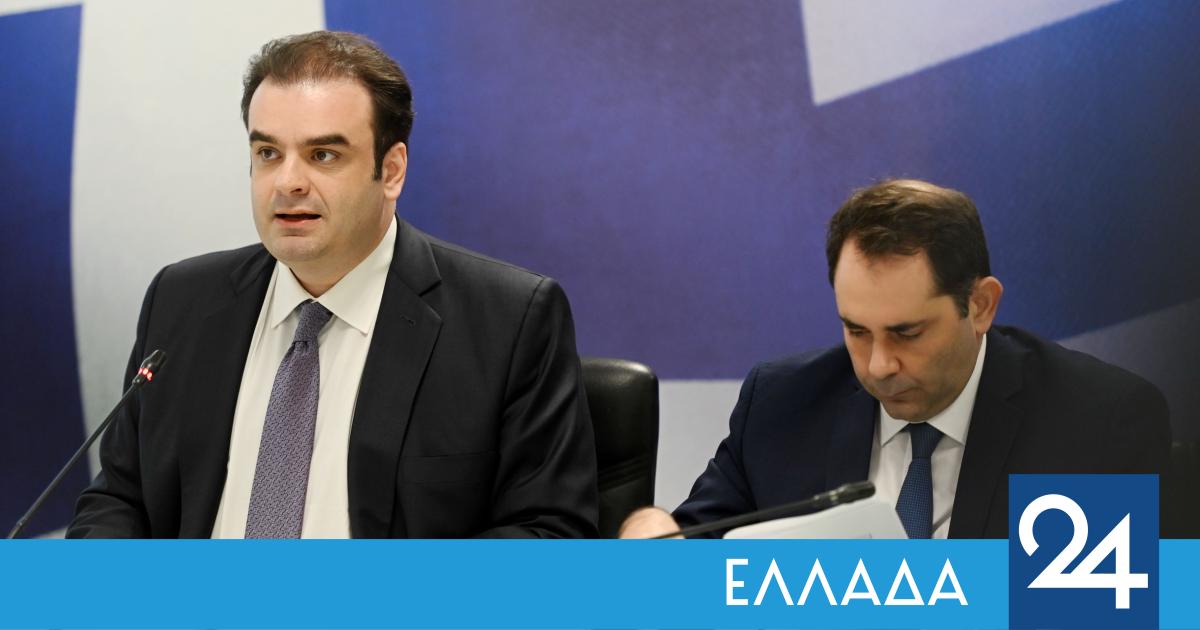
“We will support citizens, workers, businesses, production, for as long as it takes.” This was pointed out, among other things, by the Minister of National Economy and Finance Kyriakos Pierrakakis, in his speech at the “Peloponnese 2026 Forum”, on the topic “Resilient Market – Sustainable Economy”, while, as the Minister said, “the Peloponnese is treated as a region with special developmental importance”.
Mr. Pierrakakis said: “I am very happy to be here today in Mistra, in my home, let me say, in Laconia, my place of origin, at a particularly critical moment for the economy, for Europe and for our country. It is a juncture which, as the Regional Governor said before, is largely determined by the crisis in the Middle East, but also by the instability it causes in the global economy and society.”
He added that “Crises highlight, in the most powerful way, the value, weight and potential of political leadership. Governments are not judged on the easy, they are judged on the hard. To put it more schematically: they are not judged at zero wind speed, they are judged in bad weather. And in this sense, political leadership does not exist to hold the wheel only in the carefree and uneventful times. In crises you need calmness, speed in decisions and this government and its Prime Minister, its leader have proven that they can ensure and guarantee stability, especially in the difficult times, as we have been constantly faced with emerging challenges since 2019. Whether we are talking about the events in Evros, whether we are talking about the pandemic, whether we are talking about Russia’s invasion of Ukraine and the then energy crisis that followed.”
Mr. Pierrakakis then stressed that “In recent years, the region has seen a clear improvement in economic activity, consumption and entrepreneurship. As an example, I will mention that retail turnover increased 31% between ’19 and ’25, which shows the rise in consumption and overall demand in the economy.
There are more than 113 companies operating in the Peloponnese.113 000 enterprises, representing about 7,6 % of the country’s enterprises, are active in the Peloponnese. This is a very strong base, especially in terms of small and medium-sized enterprises.”
According to him, “the improvement recorded in tourism, which is one of the main pillars of the economy of the Peloponnese, is particularly important. According to Bank of Greece data, visits to the Peloponnese in 2025 increased by 16.3% compared to ’24. That is, almost three times the national average. At the same time, arrivals and overnight stays in accommodation increased, while the increase in turnover in the accommodation and catering sectors is very high, exceeding 65%. There is also a noticeable improvement in the labour market. Unemployment has fallen significantly compared to ’19, having dropped to 8.2% from 12%. The increase in employment is linked to the growth of tourism that I mentioned before, services, trade, manufacturing and shows that the economy of the Peloponnese – despite the challenges that the Regional Governor mentioned before and which are absolutely real – is constantly on a curve, on a path of improvement.”
As the Minister said, “a particularly extensive development programme is being implemented in the Peloponnese region, as the regional plan includes more than 200 projects with 5.25 billion euros in funding. euros of public investment and about 1.25 billion euros of private investment.
.
The Peloponnese is seen as a region of particular development importance, with a focus on transport, energy, productive infrastructure, resilience, investment and improving the quality of life of its citizens. The progress of the national economy is now reflected in regional development – and especially in places like here.”
He went on to say that “The crisis in the Middle East finds Greece at a time when its economy is much more resilient than in the past. I think this is almost self-evident. But we are faced with a very worrying situation, which we do not know how long it will last and what dimensions it may actually take. The key word here is the word uncertainty. Wars no longer affect not only the borders of states. They affect economies, societies and ultimately the daily lives of citizens. Especially, I would say, when they touch the energy aspect.”
“Price rises have been building up over the past few years, which is why strengthening the purchasing power of citizens is the government’s key priority. The interventions announced by Kyriakos Mitsotakis at the TIF in September were incorporated in the Budget ’26 and move in exactly this direction. The minimum wage has been increased by a total of EUR 270 from 2021 to date. It has reached 920 euros with this week’s announcements and includes increases in the public sector, because we have now linked them. At the same time, net pay after tax and social security contribution reductions is rising faster than cumulative inflation. This means a real boost to the disposable income of workers. Low-income pensioners are supported by permanent and extraordinary payments, fairer taxation and the gradual removal of the injustices of the personal differential.”
He added that “Workers are seeing increased net pay, families with children and young people are benefiting the most, while insurance contributions are being further reduced. At the same time, the ENFIA is being reduced and is being gradually reduced to zero for small settlements, including dozens in the Peloponnese. Freelancers and farmers are also boosted. Outlying and island regions are being supported with VAT reductions.
All in all, the interventions announced at the TIF accumulate, add up, aggregate the biggest tax cut of the post-independence period. It is the biggest tax reform, which had a focus on both demographics and the middle class. It had an emphasis on small settlements, as I mentioned. And its basic rationale, its core rationale, was to increase the disposable income of citizens. Precisely so that one could offset and overcome the cumulative increases that had preceded it in the cost of living and prices.
In all of this, given the events of the last few weeks – although more time seems to be running out – the fuel interventions, that is, that we announced, to support millions of workers and avoid further increases in transport, we are constantly seeking to move in that direction. We have also taken measures, as you have seen, on fertilisers, on transport, on support for coastal shipping, in order to contain prices, particularly for island regions. In total, these measures amount to around EUR 300 million for the two months of their implementation, April and May, that is to say. For fertilisers, we are starting from 15 March.”
As the Minister said, “No one will be left alone in a crisis. The state will be present. It will support citizens, workers, businesses, production, for as long as it is needed. The crisis of war in the Middle East will not become a social crisis in Greece. And this is our responsibility. And we take it fully.
The government is returning the dividend of growth to the citizens, but without proceeding with benefits without end and increases without a future. Greece has experienced endless benefits and increases with no future in the past. Today we are designing and implementing policies of resilience and sustainability, not just for the state, but for every community and every family.
Before the start of this crisis, having submitted the budget figures for this year, we were looking at a growth rate – and we are – of 2.4%, a big debt reduction. We have the largest debt decumulation in Europe.”
Mr. Pierrakakis went on to say that “The figures for the year ’25 showed 2.1% GDP growth, compared to 1.4% in the Eurozone. And even more important, if you like, is the structure of this growth. It has a focus on investment. The ratio of investment to GDP, when we delivered 2019, was 11%, to quote a number. The European average was 21% and we knew that we had to close a very large investment gap in every corner of the country.
Today, the forecast is for 17.7% in 2026. So we are constantly closing the gap that separates us from the European average in both investment and exports. Greece, since it entered the crisis in 2009, had a 20% export-to-GDP ratio. Now we are at 42%, with the European average being 51%. We are constantly closing the gap.
Unemployment has fallen to 8.9% from 17% about a few years ago. It’s one of the largest unemployment reductions in Europe in recent times. At the same time, public debt as a percentage of GDP is steadily declining. It has already fallen to 145.9%. It is projected to fall further this year to 138.2%. This reduction is the fastest in Europe, significantly strengthening the country’s credibility. The country’s borrowing needs have been covered by 50% for this year. The early repayments have eased the burden from the following years.
All these strong foundations of the economy allow us to face international turbulence with confidence. They are the first great guarantee of economic stability, of continued growth, even in an environment of international uncertainty. And here let me stress that the data we are receiving in relation to the current crisis are such that we are concerned, but we know that our country is in a much better situation than in the past.”
According to him, “The second great guarantee for our national economy is investment and European resources with the Recovery Fund as a key tool and now we are talking not only about the successful completion of this programme this year, but also about a smooth transition to the next European financial instruments that will support growth in the coming years, along with private investment of course. The new Public Investment Programme is one such programme. The European Multiannual Financial Framework ’28-34, as well as new resources of EUR 8 billion from the Social Climate Fund, the Modernisation Fund and the Island Resettlement Fund. This is in addition to the transformation of the Super Fund into a public investment fund to maximise the value of its portfolio of around €12 billion. What does all this mean? They mean that Greece today has resources, investment tools and financing possibilities for the coming years. It means that the growth of the economy is not based on the conjuncture, on cyclical factors, but on investment and on a coherent development plan. But a country supports, builds a healthy and long-term economic growth when you have established strong, fair and transparent fiscal institutions. It is in the area of combating tax evasion that the ability of each country to achieve growth with social justice is largely decided. Here too, the news is good. VAT revenue loss has shrunk to below 10% today, down from 24% in ’19.”
“Greece has now strengthened its position in Europe. It is no longer a country that simply watches developments. It is a country that is participating. And it is an active participant in the shaping of European policies. It has a role, it has a voice, it has credibility. Economic stability, fiscal responsibility, reforms, all these have restored the country’s prestige. They have strengthened its negotiating power in Europe and have enabled its Prime Minister, Kyriakos Mitsotakis, to take initiatives, whether we are talking about pandemic initiatives or defence initiatives. We are the first to send a frigate to Cyprus. All these things interact with each other – strong economy and strong national defence – and they also strengthen our own voice in the European context and at the European level,” he stressed.
In conclusion, Mr. Pierrakakis stressed that “the dividend of growth does not only translate into greater social cohesion. It also turns into a broader guarantee of security for the country. Because a strong economy means a strong country with the ability to support defence, to support diplomacy, to support its international presence. The readiness of the armed forces was demonstrated in practice with the immediate deployment of advanced armament systems, starting with the Kimon frigate in Cyprus” and added that “Greece has proven that it can act quickly, responsibly and decisively when it comes to defending national interests and ensuring stability from Evros to Cyprus. Our goal is not just to manage crises. Our goal is to build a stronger Greece in and after every crisis. This is our path. This is our responsibility. That is what we will do.”