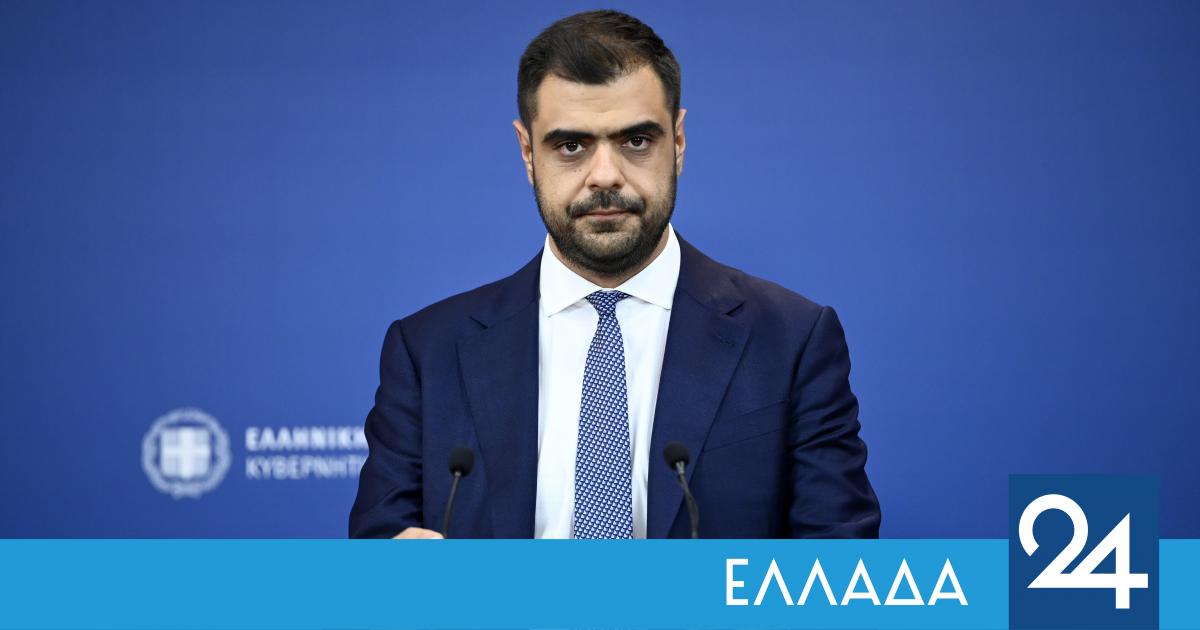
In the aftermath of the announcement of the government’s emergency measures to deal with the economic consequences of the war, government spokesman Pavlos Marinakis, in an interview this morning on the TV channel OPEN, referred to the framework and philosophy of the interventions, with emphasis on supporting society in the face of the energy crisis and precision. He pointed out that these interventions are more effective than a horizontal reduction in excise duty, due to European restrictions, and stressed that the government is prioritizing support for the most vulnerable, given the fiscal constraints. Particular emphasis was placed on the risk of the increased fuel costs being passed on to product prices, assuring that the government was closely monitoring the market and would intervene further if necessary.
“As you understand, there are certain monies that can be given. I wish there was the possibility and in any case that all the available funds could be given in advance, so that all the measures could be given to everyone, and without income criteria and even more measures – because let us not kid ourselves that citizens will not solve their problems with these measures alone, although I think they are important. So we prioritise the needs based on the problems – that is, based on who is being squeezed more. The first is this,” the government spokesman said. “The second thing I want to say is that (because I hear a criticism of the excise tax, ‘why not reduce the excise tax’) – in principle and because I am also part of a party since I was a young child that has at its core the reduction of taxes and I represent a government that has reduced or abolished 85 direct and indirect taxes – we did the following exercise: We go first to diesel. First, let’s go to diesel. How much Europe allows us to reduce it – because we do have room to reduce it. So we reduce it, instead of the 8 cents that would be reduced if we reduced excise duty, we reduce it from 41 cents to 21 cents. So we are reducing it more. Let’s go to petrol. On petrol, Europe is at 70 cents excise duty at the moment. Europe is giving us the opportunity to reduce it by 34.1 cents. We are reducing it 36 for the three quarters and 43 cents for the islands,” he added and pointed out: “So the measures announced yesterday by the Prime Minister cover larger reductions, that is, they give larger reductions than if the government had chosen to reduce the excise tax, again, for two months.”
Regarding the comparisons made with Spain, Mr. Marinakis said that Madrid is reducing fuel by 30 cents, while in our country for “petrol, which is the most popular fuel, we are reducing 36 and 43 and also the measures that Spain announced were a big package of measures concerning many other things, many of which we are implementing from 1.1.2026. That is, let us not forget that a few months ago we reduced the tax that applies to all individuals in the country, from 2 to 20%. It was reduced by 2% for everyone, 4% for those with two children, 6% based on the above children and so on, it went to 9% for those with three children and 0 for those with many children. Our tax policy is exactly that. To reduce taxes.”
On excise duty, he said that “it brings the state about 4 billion a year … So if you divide that by 12, because we are talking about two months, it is somewhere between 300 and 400 million, the total tax and not the 8 cents which is the maximum we can reduce, based on the rules of Europe, for diesel and 34.1 cents, which is about half for petrol.” He added that “the 300 million that these measures cost the state is more than the extra revenue we have as a state because of the rise in prices. That is, the state is giving more than what it can make because of the rise in prices. Because I tell you again that in one month alone, the total revenue from the excise tax, the total is 41 cents on diesel, 70 cents on petrol, the total is 300 million.”
P. Marinakis stressed that the new measures are still at the initial stage of implementation and evaluation, underlining that the Greek economy is resilient and produces surpluses, which are returned to society mainly through tax cuts or targeted interventions in times of crisis. He assured that if the situation deteriorates, the government is ready to take additional measures without exceeding the fiscal limits, rejecting past practices that have burdened future generations. He clarified that the current measures relate to 2026 and are not related to those of the TIF for 2027, which are considered to be secured, and mentioned additional revenues from taxing casino profits.
He noted that the economy is growing at a faster pace than Europe, although he acknowledged that the improvement needs to be seen more strongly in people’s disposable income. He stressed that positive macroeconomic data is a prerequisite for financing social policies, refuting criticism of overtaxation and noting that increased revenues result from lower taxes and higher growth. He also noted that the government has already implemented significant tax cuts and reforms, contributing to increased investment and job creation, while acknowledging that despite progress, there is still a way to go to improve incomes. He underlined that the assessment cath