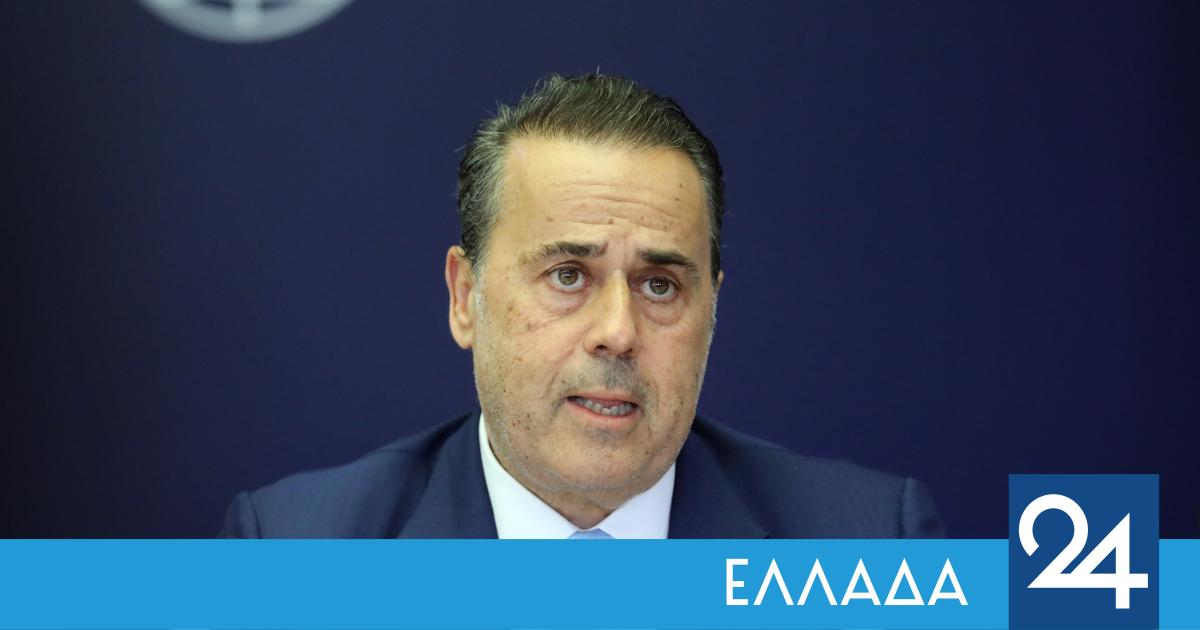
The arrival of the Chevron delegation in Athens today to finalize the agreement for the company’s entry into the so-called Block 10 off the coast of the Gulf of Kyparissia was announced by the Minister of Environment and Energy, Mr. Stavros Papastavrou, speaking on ANT1.
As he noted, following the submission of the request by the American company to participate in hydrocarbon exploration, the relevant procedures have been completed, and a meeting will be held at the Ministry at noon today to formalize this agreement, which concerns its entry into a fifth block, known as Block 10, off the coast of the Gulf of Kyparissia, in the southern Ionian Sea, which until now was held by Hellenic Energy, announced the Minister of Environment and Energy, Mr. Stavros Papastavrou, speaking this morning on ANT1 and on the program “Good Morning Greece,” with journalists Panagiotis Stathis and Stefanos Siskos. “This development demonstrates Chevron’s interest in expanding its presence in our country and essentially brings us closer to our efforts to exploit hydrocarbon resources,” the minister stated.
He noted that Chevron’s entry into a fifth offshore block in our country follows its entry into the two offshore blocks south of Crete and the two south of the Peloponnese and expands Chevron’s presence in Greece. He also reiterated that the first exploratory drilling will take place in February 2027, in the Northwest Ionian Sea, by the ExxonMobil-Energean-Helleniq Energy consortium.
Commenting on developments in the Iran-U.S. conflict, he noted that there is an immediate de-escalation of hostilities, while, according to reports, the Strait of Hormuz is also reopening. “The markets have already interpreted this, as oil and natural gas prices are falling by 5% in Asian markets. Essentially, if the agreement is confirmed, stability will be restored in the region, which will bring normalcy to the global economy,” he noted, while also emphasizing that we will continue to see the consequences of the war for several more weeks or even months. At the same time, Mr. Papastavrou emphasized once again that in Greece, from the very beginning, all companies, the relevant authorities, and the Ministry gathered around the same table and took all necessary measures to ensure the security of market supply.
Referring to his recent trip to the U.S., Mr. Papastavrou emphasized that it was confirmed there that the instrumentalization of energy, whenever and wherever it occurs, is reprehensible. Meanwhile, referring to the 3+1 (Greece, Cyprus, Israel, and the US), he emphasized that their cooperation for the development of the energy sector in the Eastern Mediterranean was reaffirmed, through the adoption of a specific framework of principles and rules that excludes coercive behavior and threats.
Finally, regarding urban planning, Mr. Papastavrou emphasized that no one is above the law. “There is an intention and a government policy to bring everything to light, and the Prime Minister has stated this from the very beginning,” he noted. He also noted that when urban planning responsibilities were transferred to municipalities in 2010, it was viewed as a positive development in the context of decentralization because it brought decision-making closer to the citizen. However, “in practice, this created gaps and overlapping jurisdictions, which, combined with the proliferation of laws, left room for malfunctions, different interpretations, and allowed conditions for opacity to arise.” A problem that, as he said, is corrected by the recent “Nikolaos Tagaras” Spatial Planning – Urban Planning “Nikolaos Tagaras,” which essentially codifies 180 different laws and presidential decrees into 477 articles. “Now we know what applies,” he said characteristically. At the same time, he referred to the great importance of the reform that introduces “a gov.gr for urban planning,” “so that there is a digital record of the file and the plot, thereby limiting the human factor, as was done previously with tax offices.”