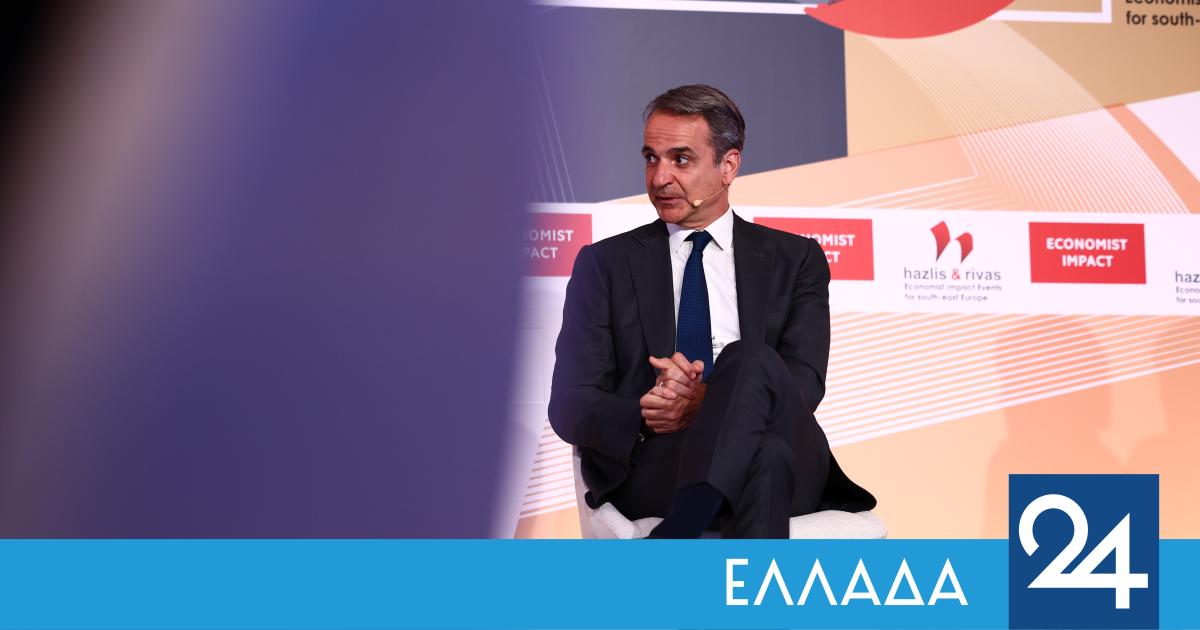
The geopolitical landscape, international alliances, the war in Ukraine, developments in the Middle East, European defence and the challenges posed by artificial intelligence were the main topics of discussion between Prime Minister Kyriakos Mitsotakis and CNN journalist Christiane Amanpour.
The discussion took place in the context of the event “Mapping the Future”, organised by iefimerida.gr in cooperation with the Economist, where the Prime Minister spoke about international developments and Greece’s position in a volatile global environment.
Referring to the country’s role internationally, Kyriakos Mitsotakis noted that Greece has historically chosen the right side of history, referring to the political legacy of Eleftherios Venizelos. He also stressed that the strength of a state depends on its economic base, reforms and its ability to read international developments in time.
He said that Greece, as a member of the European Union and NATO, is at a strategic crossroads of three continents and is directly affected by global developments. At the same time, he stressed that the country has restored its credibility in Europe and is now actively involved in shaping European decisions.
As regards international cooperation, the Prime Minister particularly highlighted the strengthening of relations with the Gulf countries, as well as the strategic cooperation that has been developed with India. He stressed that in an environment of constant geopolitical changes, alliances are a key factor in defending national interests.
Referring to international conflicts and their economic consequences, Kyriakos Mitsotakis noted that uncertainty has become a permanent feature of global reality. He made special reference to the Strait of Hormuz, stressing the potential impact on energy and international economic stability, as smooth navigation and the course of oil prices remain critical issues.
He also said that Greece, after the pandemic, managed to raise wages, reduce unemployment and contain inflation, while maintaining a growth path. He placed particular emphasis on the war in Ukraine, which he described as a European crisis with wider geopolitical implications.
He stressed that Greece has always defended international law and the principle that borders cannot be changed through the use of military force. He also recalled the historical ties with Mariupol due to the Greek expatriate community and noted that European sanctions put pressure on Russia. At the same time, he stressed that any peace process must be accompanied by substantial security guarantees for Ukraine, and rejected conditions that include ceding territory.
On the issue of Europe, the prime minister referred to the need to strengthen its geopolitical role. He said that common European defence and deepening defence cooperation are key priorities for the coming years, at a time when democracies and the rule of law are under increasing pressure.
Citing Mario Draghi’s report on European competitiveness, he noted that the EU must adapt to a new international order. At the same time, he reiterated the strategic importance of Greece’s relations with both the European Union and the United States.
He concluded by stressing that Greece is firmly seen as a pillar of stability in the Eastern Mediterranean and that geopolitical developments create new opportunities to further strengthen its international position
Mitsotakis: Macroeconomic stability is non-negotiable. While other countries are plagued by deficits, Greece is on a steady course. pic.twitter.com/y0mep3Ef5r
.
– ELLADA 24 (@ellada24) June 9, 2026