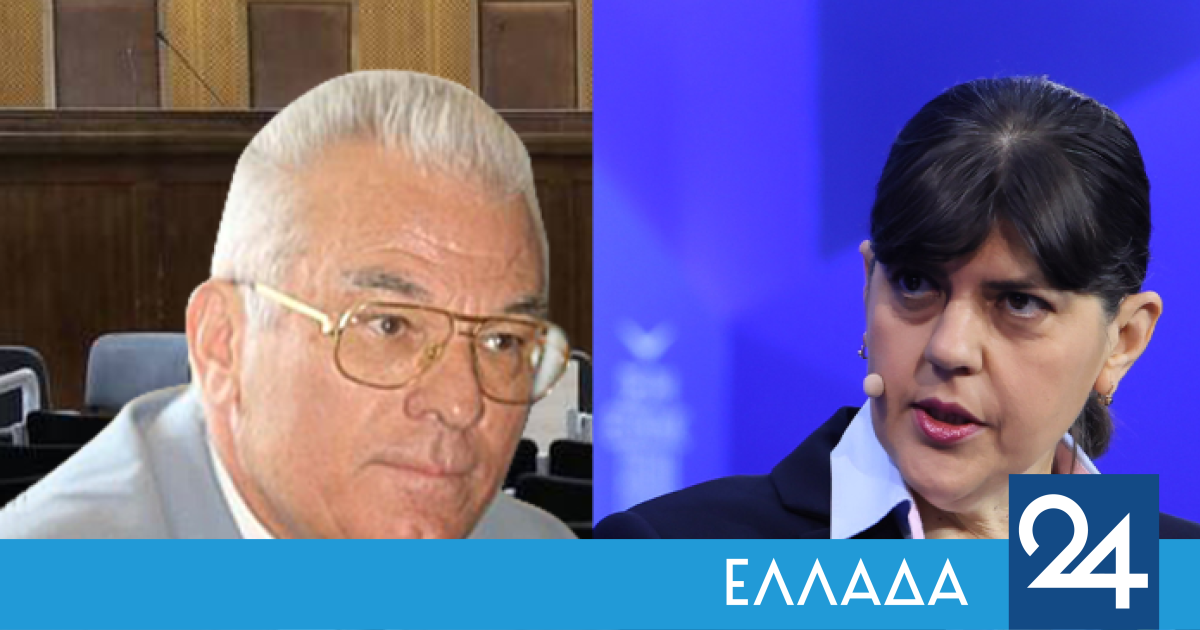
The former Prosecutor of the Supreme Court, Georgios Sanidas, made a significant intervention, analysing with legal rigour and institutional depth the fierce confrontation that has erupted between the European Public Prosecutor’s Office and the Greek judiciary. On the occasion of the recent public statements and disagreements of the head of the European Public Prosecutor’s Office, Laura Covesi, regarding the term of office of the Greek prosecutors and the management of sensitive cases, the senior former prosecutor clarifies the limits of competences and national sovereignty.
Through his text, Mr.Sanidas documents why the claims of the College of European Public Prosecutors for exclusive competence in the renewal of terms of office lack legal basis, contradicting both the European Regulation and Greek legislation.
At the same time, it is harshly critical of interventions that touch on constitutional institutions, such as the procedures on the criminal liability of ministers and parliamentary immunity, stressing that Greece has an effective rule of law that acted to protect European funds long before the EU institutions were set up.
Finally, the intervention sheds light on specific procedural lapses in recent investigations into the OPEKEPE, while raising the question of the appropriateness of the excessive number of European Public Prosecutors in our country.
Intervention C. Sanida’s intervention in dikastiko.gr.
A. The European Prosecutor General Laura Covesi, had and has the position, which was adopted by the College of European Prosecutors, with its decision issued on 12.11.2025, on the renewal of the term of office of three of the appointed Greek prosecutors, approximately eight months before the expiry of their term of office, that only the said College had the exclusive right to the above renewal, and indeed for five years, and that the Supreme Judicial Council of Greek Civil and Criminal Justice (which had decided five years ago on the above appointment), had no jurisdiction, competence or right to take up the matter, and in any case, if it did, it would have to be fully aligned with its own position and the position of the College of European Public Prosecutors.
In fact, Laura Covesi initially pressed everywhere and unsuccessfully, sometimes even with threats, that she would take our country to the European Court of Justice and the European Commission (the latter has already done so), namely both the executive and the leadership of the judiciary, in order to comply with the above position of the College of European Public Prosecutors, which was also her own position.
The Hellenic Council of Civil and Criminal Justice was opposed, and rightly so, to the above position, and renewed the mandate of the three Greek appointed European Public Prosecutors for two years only, in order to complete the investigations in the pending cases they have.
The aforementioned Court of Justice took action, after the European Public Prosecutor General sent a relevant question, which, formally at least, changed its position on the issue of the primary competence of the Supreme Judicial Council of Greek Civil and Criminal Justice, but considers its decision to be unlawful, as regards the limited renewal period, i.e. renewal for two years, whereas it should have decided for five years.
But both the original position of the European Public Prosecutor General and the College of European Public Prosecutors, as well as the maintained opposing position as to the length of time that the mandate of the three prosecutors should be renewed (five years instead of two years) is manifestly unlawful and arbitrary, since it contradicts both the Council Regulation (EU) 2017/1939 of 12 October 2017, as well as L. 4786/23.3.2021, which implemented the above Regulation.
In particular:
With Article 17 par. 1 and 2 of the said Regulation set out the following:
“1. On a proposal from the European Public Prosecutor(s), the collegiate body shall appoint the European Public Prosecutor(s) designated by the Member States. The collegial body may reject a person nominated if he or she does not meet the criteria set out in paragraph 2. The term of office of the European Public Prosecutors appointed shall be five years and may be renewed.
- The European Public Prosecutor(s) appointedfrom the moment of their appointment as European Public Prosecutor(s) until their term of office, they shall be active members of the Prosecuting Authority or the judiciary of the respective Member State(s) that nominated them. They shall provide guarantees of independence and shall have the necessary qualifications and appropriate practical experience in their national legal system.”
Finally, by Article 13 para. 3 of the same Regulation, sets out, inter alia, the following: “European Public Prosecutor(s) may also exercise the functions of national Public Prosecutor(s), provided that this does not prevent them from fulfilling their obligations under this Regulation…”
.
In addition, Article 9 para. 1 and 6a of Law 4786/23.3.2021, it is stipulated that:
“1. The selection of candidates for appointment as European Public Prosecutors is carried out by the Supreme Judicial Council for Civil and Criminal Justice, in accordance with the procedure laid down in Articles 49, 50 and 51 of the Code on the Organisation of Courts and the Status of Judicial Officers (Law 1756/1988)…
.
- a. Full-time European Public Prosecutors shall, immediately after their appointment, be transferred or seconded and placed, in accordance with Articles 49, 50 and 51 of the Code on the Organisation of Courts and the Status of Judicial Officers, in the Office of European Public Prosecutors until their term of office expires. … In the event of renewal of their term of office, the same procedure shall apply…”.
In view of the above, it is obvious that the European Public Prosecutors appointed, who, moreover, are based in the State which nominates them for this post and after taking up their duties, continue to be organic members of the Greek Civil and Criminal Justice system and thereafter, for any change in their official and personal status, the said Supreme Judicial Council remains competent, whose decision must be preceded by a decision, before their appointment as European Public Prosecutors, at the request of the European Public Prosecutor(s).
In view of the above, it is obvious that it would be not only unlawful but also unthinkable to insist on the position that, for the renewal of the term of office of those appointed as European Public Prosecutors, a decision of the Supreme Judicial Council of Civil and Criminal Justice is not required beforehand, of the State which nominated them, which they represent and to which they belong organically, but the decision of the College of European Public Prosecutors and the European Public Prosecutor General shall suffice for that purpose.
This, moreover, which even first-year law students would not support, is expressly excluded by the provision of Article 9 para. 6a, last paragraph, which stipulates that “in the event of renewal of their term of office, the same procedure shall apply.
Furthermore, however, the position of the European Public Prosecutor General and the College of European Public Prosecutors that in the event of renewal of the mandate of the European Public Prosecutors appointed, this should be for a mandatory period of five years is not lawful either, because: 1) this is not provided for in the provision of Article 17 para. 1 of COUNCIL Regulation 2017/1939, but both the renewal and the extent of the renewal is left to the discretion of the institution of the State represented by the first appointed European Public Prosecutors, which in this case is the Supreme Judicial Council of Civil and Criminal Justice of Greece, which obviously takes into account, among other things, the operational needs of the Greek Public Prosecutor’s Office, and (2) it is not reasonable that the renewal itself, which is the major factor, should be potential and that the minor factor, which is the time of renewal, should necessarily be five years.
B. Laura Covesi, however, unjustly – benevolently interferes in the Greek legal order with suggestions and statements that go beyond the jurisdiction of the said Regulation 2017/1939. And not only that. The issues and matters in respect of which she interferes are issues and matters regulated by the Greek legal order and, above all, by the Constitution, in respect of which she has neither jurisdiction nor do they fall within her duties as European Public Prosecutor General.
Thus, in particular:
I. The adoption or amendment of Constitutional provisions and their content is the exclusive task of the competent organs of the Greek legal order and, in particular, of the Parliament. Therefore, its suggestions, and indeed repeatedly, for the amendment of Article 86 of the Constitution, constitute a premature conduct of an institution of the European Union, which either ignores or conscientiously does not respect the extent of its jurisdiction and its duties, which derive mainly from COUNCIL REGULATION (EU) 2017/1939 of 12.10.2017.
I. She has also stated in previous statements that the immunity provisions for Members of Parliament and Ministers should be repealed, which are also beyond the scope of her duties as deleted in the said REGULATION 2017/1939.
First, there are no provisions on immunity for ministers. There is a special procedure for investigating the criminal liability of ministers, as to which there are concerns and plans to replace them, and about which she has no right to intervene and suggest, as it is a matter of concern to our state.
As to the immunity of Members of Parliament, we will observe that this too is a matter alien to her duties and powers as they arise under the said Rules, and the least we can say is that her statements in this regard are also prejudicial.
Much more so when the existence of immunity in Member States of the European Union for certain persons is known and accepted by the Council Regulation 2017/1939 of 12 October 2017, which is the reason why it urges the European Public Prosecutor’s Office, in the event that due to the immunity the ongoing investigation concerning such persons is hindered, to submit a reasoned written request for the waiver of the immunity covering such persons (Article 29(1) of the said REGULATION).
PII. The European Public Prosecutor General complains that a provision has been introduced to be passed by the Parliament to expedite the trial of cases of abuse against the European Union when Members of Parliament are allegedly involved in them, because this would impede the thorough investigation of such cases.
It would be preferable, before expressing its protest on the above matter:
1) recall that she had been consulted (in our view wrongly) by the Ministry of Justice, about this arrangement and had expressed her satisfaction and approval, and
2) to have investigated: (a) why the two appointed European Public Prosecutors held the file, which allegedly involved MPs, as stated in their request submitted to the President of the Parliament, for almost three years, during which they could have investigated the case fully (besides, the action of preliminary examination, under Article 244 of the Greek Criminal Code may not exceed 10 months) b) why, while the case was under investigation, the names of Members of Parliament and ministers allegedly involved in the alleged abuses against the European Union began to be made public; c) who made them public, although the interrogation was secret; d) why, for three years, the appointed European prosecutors did not invite all those involved in the cases under investigation (except for the Members of Parliament, whose immunity had to be lifted beforehand) to provide explanations, as they were obliged to do under Article 244 of the Greek Criminal Code, in order to form as complete a picture of the case as possible, and to request the lifting of the immunity of the MPs who would have evidence against them, but they started the investigative proceedings by sending a request for the lifting of the immunity of the MPs who were being investigated as perpetrators of the perpetrators or instigators of the perpetrators!!!!, and e) why, while they had ordered an expert opinion, in order to determine whether there was damage and what the amount of damage to the European Union was, they did not wait for the conclusion of the expert opinion, which showed that in most cases there was no damage to the European Union, but rushed to request the lifting of the immunity of the Members of Parliament, which, for reasons that they obviously know, they announced to the media.
And it would be imperative to investigate further when the expert action was requested and when exactly the expert report came into the hands of the appointed prosecutors.
But regardless of this and beyond this, could not someone in bad faith assume that all this did not happen by chance, but is the result of the thoughts and intentions of the two European Public Prosecutors, perhaps in cooperation with the European Public Prosecutor General, which are not related to the mission and purpose of the operation of justice, a thought which we, of course, do not share?
- Laura Covesi should realize and accept that the Greek Justice System, in cooperation with the individual Greek law enforcement authorities (such as, among others, the Authority for Combating Money Laundering, the National Transparency Authority, the Independent Public Revenue Authority, the Sub-Directorate for the Prosecution of Financial Crimes of the Greek Police, etc.etc.), for the protection of the economy and property of the European Union, and especially for the issues of the issues of European funds received illegally through subsidies and financial aid, has always made efforts to uncover this type of criminal behaviour and punish those responsible.
As regards in particular the financial aid given to farmers and livestock farmers through the OPEKEPE and the illegalities that took place, the Greek authorities have acted and have taken action long before the European Public Prosecutor’s Office was set up and taken action. This is confirmed by the many arrests and trials that have been and are being carried out and the sentences imposed in trials and convictions that have started with investigations by the Greek judicial authorities, with the support of the Greek law enforcement authorities.
After all, the convictions of many people in the prefecture of Serres, the arrests of organized criminals in the regions of Crete and Thessaloniki are well known, while there are several trials in progress throughout Greece. These confirm that the Greek Justice and the Greek prosecuting authorities are acting with speed and efficiency to protect the financial interests of the European Union, which are also the financial interests of law-abiding Greek citizens.
Thus, with the above, it is confirmed that Greece is a rule of law and indeed much better than many others, and any contrary objections against it, which have been expressed unfairly – fair and by the European Public Prosecutor General, are clearly due to incomplete or false information and to the support of similar positions within and outside our country, even before the European Parliament, by various people, for reasons, aims and purposes that they know, regardless of whether this behaviour makes them “Matraloi” or “Brutus”.
C. As can be inferred from what has been exposed so far, mischief, unlawful actions, violation of procedural provisions and especially the provision of Article 244 para. 1 of the Code of Criminal Procedure, in relation to the case in question, have also been committed by the two appointed European Greek prosecutors, Poppy Papandreou and Dionysios Mouzakis, in handling the case in question.
We think it wise to briefly highlight some of them:
1) First of all, they kept the specific file in their hands for three years, without proceeding to the action of investigative acts.
2) At the end of March 2026, mainly on the basis of the Report of Actions No. 769/23.3.2026 submitted by the competent preliminary investigation officer of the Sub-Directorate for the Prosecution of Economic Crimes of the Hellenic Police, in the context of the investigations of 18.9.2025 and 12.11.2025, for the conduct of a preliminary investigation, and which (report), as can be concluded, is based on the intercepted (legally) conversations between the 2021 President of OPEKEPE, Demetrios Melas and the 11 members of parliament, but also some other conversations, they prepared a “report” called “Annex – Detailed reasons for the request” which has been attached to the 31.3.2026, to the President of the Hellenic Parliament, a document of the European Public Prosecutor General, which requested the lifting of the immunity of 11 MPs, allegedly involved in the cases mentioned therein, against the OPEKEPE and, by extension, the European Union.
At the end of the above report (Annex), the following is stated verbatim: “…”The waiver of the immunity of the eleven (11) sitting members of the Greek Parliament … is necessary in order to allow the investigation to proceed.”
3) In relation to the statements made in the document of the two European Public Prosecutors entitled “Annex – Detailed Reasons for the request”, the following should be noted:
a) It is a falsehood that it is stated in the above Annex that it is necessary (the waiver of immunity) in order to allow the investigation to proceed. This is because the investigation could have started and proceeded with the examination of the other participants (other than the 11 MPs), and the examination of them would have revealed whether or not it was necessary to examine all or some of the MPs and hence the necessity of lifting immunity.
The move by the two European Public Prosecutors is not only absurd but also strange, in view of the announcement in the media of the names of the Members of Parliament whose immunity was sought to be waived and their subsequent defamation, bearing in mind that the inquiries are secret.
b) The text of the two European Public Prosecutors, as it is now called, should have been a simple, informative note, perhaps accompanied by the conversations revealed by the interception, without any characterisation and without the Members of Parliament appearing as suspects, much less as accused.
B) The text of the two European Public Prosecutors, as it is now called, should have been a simple, informative note, perhaps accompanied by the conversations revealed by the interception, without any characterisation and without the Members of Parliament appearing as suspects, much less as accused.
But while in some cases they are referred to as suspects, in order to cover the press, they are in fact treated as accused and even as guilty defendants, and the entire text of the “Annex” could easily be described as a conviction, from which only the sentences are missing.
What is strange, however, is that this tactic is also followed for allegedly involved in this case (President and officials of the OPEKEPE, farmers, stockbreeders, farmers, etc.) without having previously been summoned and given explanations, in accordance with Article 244 para.
In confirmation of the above, we shall quote some extracts from the “Annexure”:
aa) p. 1: “In Athens, during the period from 16.3.2021 to 27.7.2022, the suspects, among others D.M. … A.K. …, i.e. by committing the act of dishonesty by converging individual acts … knowingly caused certain damage to the property of another, of which, under the law, they have custody and management … and the damage caused exceeds the amount of 120,000 euros …”,
b) sheet 7, p. 13: “In Trikala, on 2.3.2021 the suspect S.S. … performed the crimes described below … Subjectively, the above suspected veterinarian acted with direct malice (knowingly)…”.
D. In our view, the number of ten European Public Prosecutors appointed in Greece is excessive, even in comparison with other, much larger in population than Greece, states (such as France, Germany, Spain), where the number does not exceed seven. Besides, as far as we know, the European Public Prosecutors appointed in Greece essentially receive ready-made files from the Greek prosecuting authorities, which, as a rule, include their findings, which are the result of the evidence collected, The European Public Prosecutors themselves may have requested the compilation of these findings, and on the basis of this information, they exercise the appropriate prosecutions and refer the cases and the accused (if they have been arrested) to the “European” investigating magistrate in Athens.
As far as we know, they do not participate in investigations, nor do they carry out investigative acts, both within the Athens area and within the rest of the Greek territory, although they are obliged to do so.
In view of these facts, the appointment of ten European Public Prosecutors for Greece is excessive and should be reduced. This further means, however, that the request of the European Public Prosecutor General to increase the number of European Public Prosecutors appointed by three should not be accepted. If these remain, the posts of the European Public Prosecutors in Greece will be very good “fallow” posts, with a salary three times or more higher than that of the other Greek Public Prosecutors.
Source: dikastiko.gr