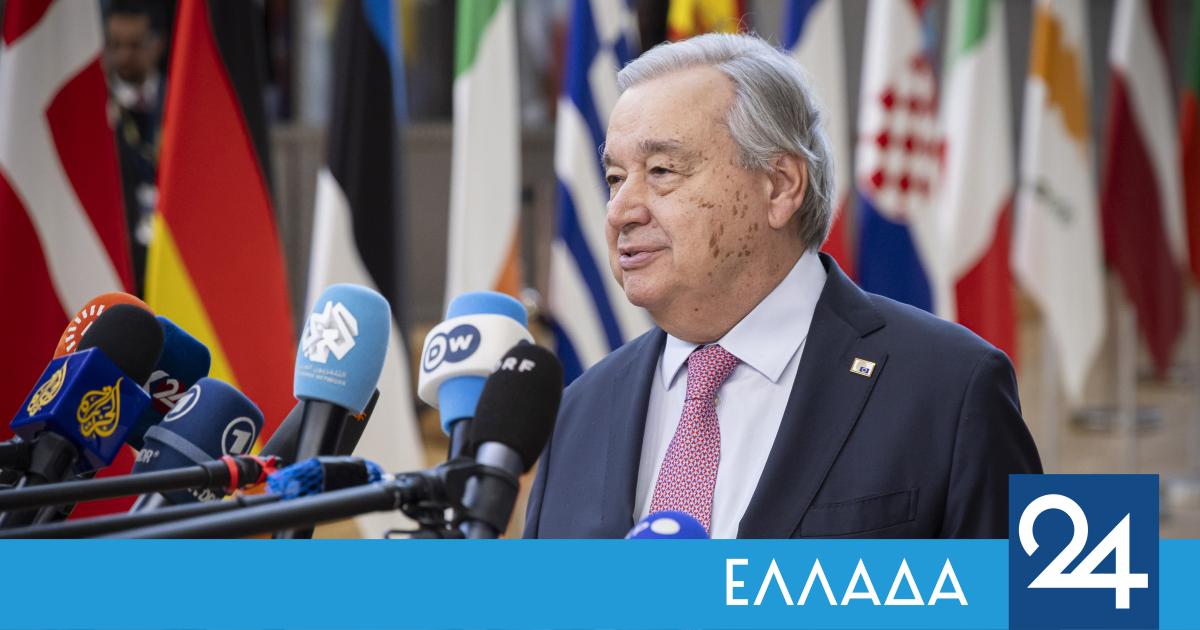
The UN Secretary-General, in remarks to the press at the Organization’s headquarters, warned that the crisis in the Middle East is entering its second month with a growing risk of generalized regional conflagration.
He said “every day this war continues, human suffering increases”, while “the scale of destruction grows”, as does “indiscriminate attacks” and “the targeting of civilians and civilian infrastructure”.
He warned that “we are on the brink of a wider war that will sweep across the Middle East, with dramatic global repercussions.”
The Secretary-General focused in particular on the international consequences of the crisis, noting that “the conflict is already being felt everywhere”, with a prime example being the impact of restrictions on freedom of navigation. As he pointed out, “when the Strait of Hormuz is ‘strangled’, the world’s poorest and most vulnerable cannot breathe,” referring to the impact on food and energy prices from the Philippines to Sri Lanka to Mozambique.
He stressed that despite the uncertainty of the conflict, one element is clear: “if the drums of war keep beating, the escalation will only exacerbate everything.” For this reason, he reiterated that “the spiral of death and destruction must stop.”
The spiral of death and destruction must stop.
Referring to ongoing diplomatic efforts, he noted that initiatives are underway for a peaceful way forward, which “deserve the space and support to succeed”, firmly based on international law and the Charter of the United Nations. He stressed that “disputes must be resolved peacefully”, that “the sovereignty and territorial integrity of all member states must be respected” and that “civilians and civilian infrastructure, including nuclear facilities, must be protected”.
Guterres also said he was maintaining close contact with the parties involved and was sending his personal envoy Jean Arnaud to the region to support those efforts.
Guterres said he was also maintaining close contact with the parties involved.
In a direct message to the parties involved, he addressed the US and Israel, stressing that “it is now time to stop the war that is causing enormous human suffering and is already triggering devastating economic consequences.” At the same time, he called on Iran “to stop attacking its neighbours”.
Finally, he recalled that the UNSC has condemned these attacks and reaffirmed the need to respect the rights and freedoms of navigation along critical maritime corridors, including the Straits of Hormuz.
“Conflicts do not end alone. They end when leaders choose dialogue over destruction. That choice still exists – and it must be made now.”