In a move that highlights the leading role that Greece, under the leadership of Prime Minister Kyriakos Mitsotakis, is playing in the new geopolitical energy architecture, US President Donald Trump has made a move, the Ministry of Environment and Energy said.
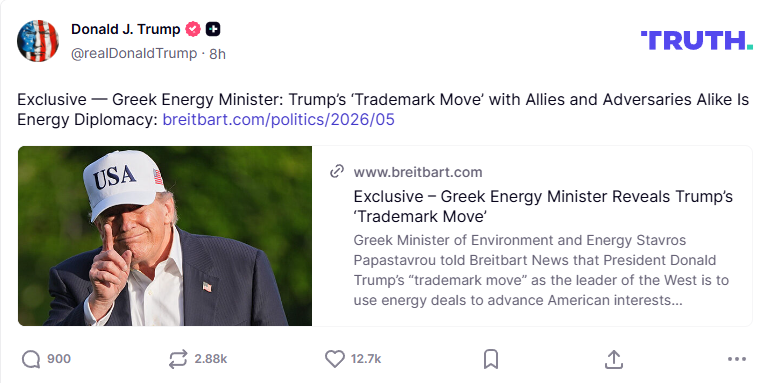
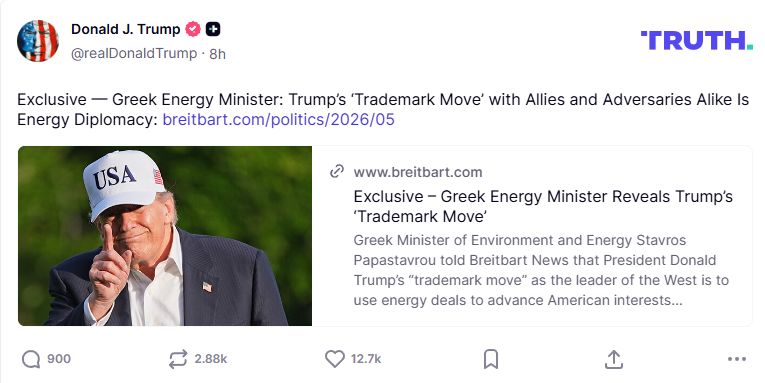
Through his personal account on Truth Social, Mr. Trump republished the exclusive interview with the Minister of Environment and Energy, Stavros Papastavrou, in the most influential US government outlet, Breitbart News.
This post takes on added weight as Mr. Trump has just returned from Beijing, where he held a summit with Chinese leader Xi Jinping, with whom he discussed global energy policy issues, among other things.
The interview with Mr. Papastavrou’s interview with Breitbart, on the sidelines of the Delphi Forum, unfolds the strategy of energy realism, on the basis of which Greece-US cooperation is moving.
The Minister said that Greece is following the vision of “realism” in energy, promoting both hydrocarbons and Renewable Energy Sources.
“No or just sun and wind, or just hydrocarbons. All of it: wind, solar, hydro, hydrocarbons, hydro, geothermal – everything. For Europe this is a wake-up call. Because Europe is the biggest customer of the US in LNG imports. At the same time, there have been several reluctant or ambivalent EU member states to develop their own gas fields. Europe is dependent on gas, but has been unwilling to accept that gas should be part of the energy mix for years to come. President Trump has brought realism. And we see that in Greece’s approach.”
“The big picture is this: for many years – for decades – Greece had not exploited this hydrocarbon potential,” Papastavrou said.
“Now is the moment when the Mitsotakis government is moving at an accelerated pace in this direction. The world’s two largest US energy companies, Chevron and ExxonMobil, have expressed interest and are actively involved. ExxonMobil, in a joint venture, will carry out the first exploratory drilling in Greece in almost half a century, in the Ionian Sea, specifically in the so-called Block 2. It will be the first drilling at great depths, reaching 4,600 metres. All previous exploration in Greece, 40 years ago, had been done in shallow waters. Greece’s potential lies in deep waters around the country. This can have a transformational impact for the country.”
Papastavrou said that energy diplomacy was the framework on which Trump’s trade agreements and key alliances such as the 3+1 scheme between Greece, Cyprus, Israel and the US were built. It has a geopolitical dimension. It is absolutely linked to national security. This is the basis of the 3+1 initiative.
He also stressed that US-Greece relations are at their highest level in decades, with energy – along with defence cooperation – being the key strategic pillar.
“Doug Burgum has visited Greece twice. Chris Wright as well,” he said.
“Energy has become the second strategic pillar, after defense, in US-Greece relations. In a way, it has also become a bridge between Europe and the US, as part of the basic trade agreement between the EU and the US involves the purchase of US energy by the European Union.”
He concluded by saying that “the US and Greece are closer today than ever before, and energy – along with defense cooperation – are the two key pillars of that relationship.”
In a recent interview with the same media outlet, the US Secretary of the Interior and head of the Energy Sovereignty Council had stressed: “We have an opportunity with U.S. natural gas to move up from Greece and Croatia and down from Poland. Ukraine has huge underground gas storage capacity. They can store enough for a whole winter. We could fill these storage facilities all summer long when gas prices are low.”
Mr. Bergham mentioned dozens of shipments of US LNG to Greece, something Papastavrou also confirmed in his interview.
In highlighting the strategic relationship between Greece and the US in energy, Papastavrou said: “Greece, on a stand-alone basis, is the 16th customer of the US,” he said. “85% of the LNG we import comes from the US. The vertical corridor faced a regulatory problem because until now Europe has only allowed monthly contracts, which – if you imagine trying to supply Ukraine with monthly contracts – is essentially impossible. Now, after contacts we have had with other countries and with the European Union, from next October the idea is that contracts can be monthly, quarterly and annual.”