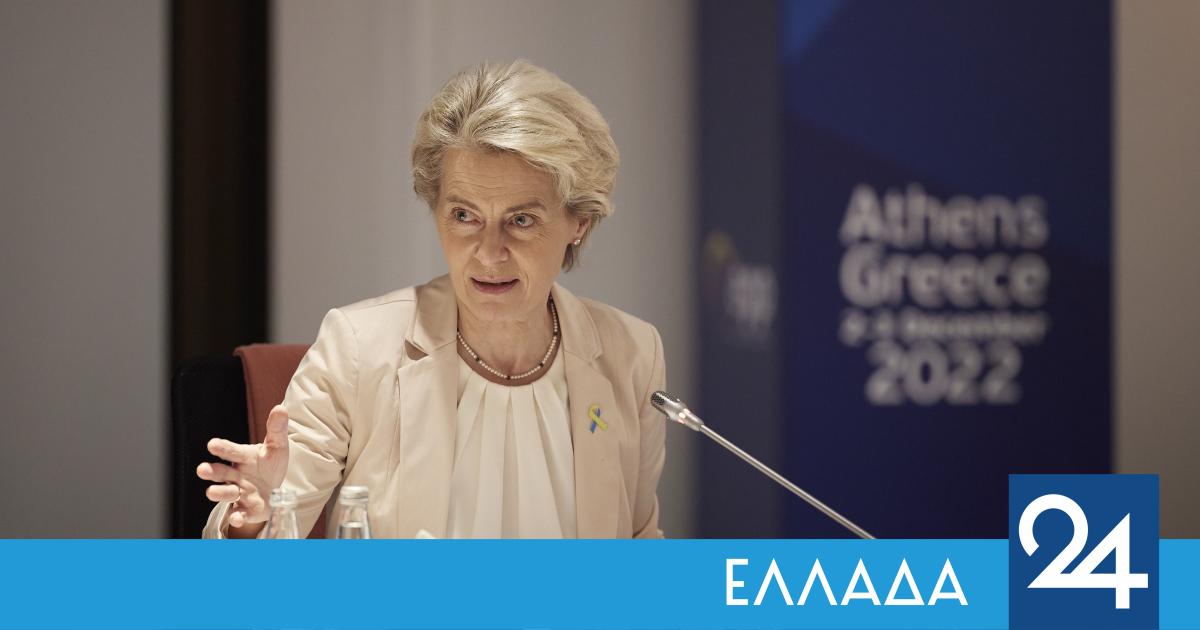
The package of new restrictive measures against Russia proposed by the European Commission to be included in the 21st package of sanctions was presented today by European Commission President Ursula von der Leyen, aimed at maintaining economic pressure on Moscow and limiting its ability to finance the war in Ukraine.
As announced by the Commission President, the new package focuses on energy, financial services and cryptocurrencies, trade, and – for the first time – fisheries.
In the energy sector, the Commission proposes to suspend, until January next year, the automatic adjustment of the price cap on Russian oil, citing the turbulence in international energy markets due to the crisis in the Middle East and problems in global supply chains. According to von der Leyen, the move is aimed at stabilising markets while keeping pressure on Russian revenues.
At the same time, the Commission is proposing to impose sanctions on another 30 ships in the so-called “shadow fleet” used to transport Russian oil, bringing the total number of targeted ships to more than 660. For the first time, ships or companies providing support services to this fleet, such as refuelling, are also targeted. In addition, measures are proposed against ports, airports and refineries involved in the handling or processing of Russian oil, as well as restrictions on the sale of liquefied natural gas (LNG) tankers to Russia.
In the financial sphere, the European Commission is recommending extending trading restrictions to 31 additional Russian banks, as well as 20 banks, cryptocurrency companies, platforms and third-country oil traders that Brussels says make it easier for Russia to circumvent Western sanctions. For the first time, the possibility of imposing a complete ban on the provision of cryptocurrency services by third-country operators is also provided for, with the Commission saying the measure will act as a deterrent against platforms that facilitate Russian access to the international financial system.
In the trade area, new restrictions are proposed on exports of technologies and materials used by the Russian defence industry, including metals and alloys for aerospace and defence production. Specifically for drones, export bans on ground support equipment, jamming systems and launch systems are proposed.
In parallel, the Commission is proposing new import bans on products worth a total of around €60 million, including certain metals, ores and car parts, with the aim of further decoupling the European market from Russian imports.
Special emphasis is placed for the first time on the fisheries sector. The proposal provides for significant restrictions on imports of some fisheries products and a complete ban on others, including cod.
Finally, von der Leyen announced that the Commission is proposing an EU entry ban for persons who have served in the Russian armed forces since the start of the invasion of Ukraine. “Europe must remain closed to those who participated in the invasion against Ukraine,” she said.
EU PIRATES HURT RUSSIAN ECONOMY
Ursula von der Leyen argued that “the consequences of the sanctions packages are having an effect” and EU sanctions continue to hurt the Russian economy. As she noted, the cost of the war for Russia is increasing daily and is mainly borne by the Russian population, which is “mourning losses” and facing a deteriorating standard of living, with inflation close to 6% and interest rates at 14.5%. According to her, the sanctions “have effectively cut Russia off from international capital markets”, economic growth is slowing, fiscal margins are tightening and energy revenues have fallen significantly.
The Commission President also highlighted the escalation of Russian attacks in Ukraine, as well as violations of European airspace, citing drones that have entered areas of the Baltic Sea and along the EU’s eastern border. He also referred to recent incidents, including the drone downing of a residential apartment building in Romania and the explosion in the port of Constanta. “Some call it an escalation by Russia. I see it differently. It’s just a failure,” he said, adding that four years after the full-scale invasion began, “Russia has clearly failed to subdue Ukraine.”
EU CONTINUES SUPPORT FOR Ukrania
Ursula von der Leyen referred to the EU’s continued support for Ukraine, which she described as a “brave neighbour, partner and future EU member”. She said yesterday that the EU had made almost €3 billion available from the Mechanism for Ukraine, with the first disbursement from the €90 billion loan to Kiev expected in June. In total, by the end of the month, the EU will have provided €6 billion for drones and more than €3 billion in macro-financial support, with further disbursements to follow in the next few months.
The Commission President finally announced that in the coming days the EU will open the first negotiating chapter with Ukraine and Moldova, marking the start of the next phase of their accession path. He stressed that Ukraine is making “excellent progress” on reforms and pre-conditions and “now is the time for us to deliver”, noting that “the Commission is fully ready to support Ukraine on its path towards the EU, where it belongs.”