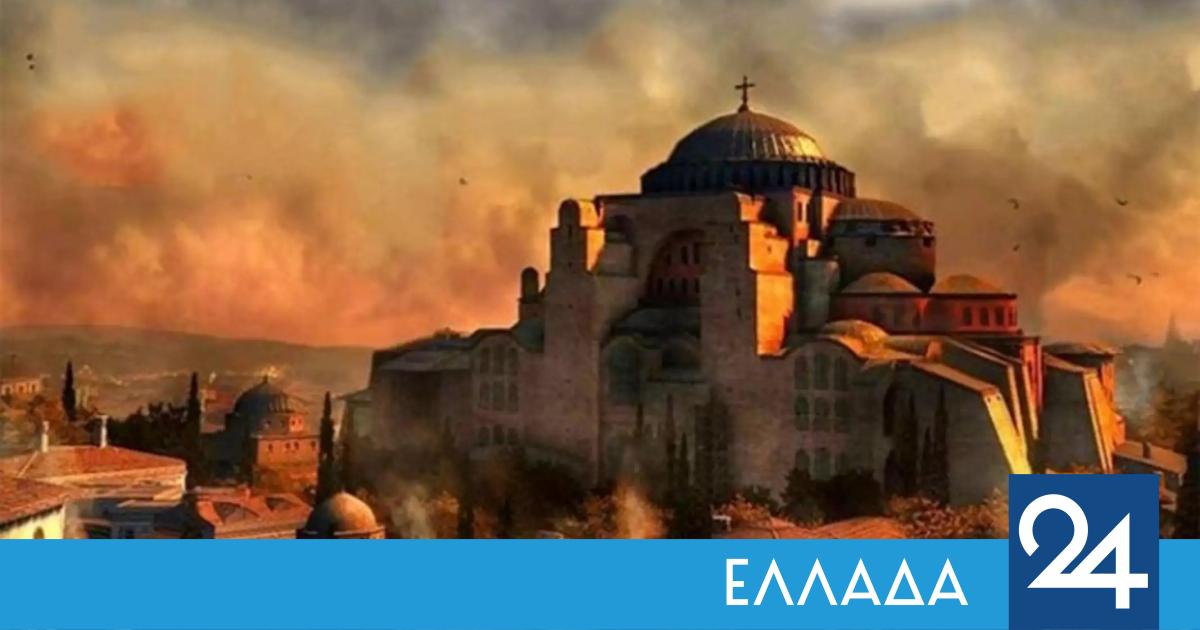
The Ottoman Turks – from their victory over the Byzantines at the Battle of Vathi (1301) – annexed more and more territory, first in Asia Minor and then in the Balkans, gradually leaving Constantinople with the title of a kingdom without subjects.
There are ongoing contacts with the West, which is concerned about its interests in the Eastern Mediterranean from the Turkish incursion, but offers military aid in religious exchange: Union of the two Churches and submission to the Pope.
Popular anger against religious blackmail leads to the dominant notion of “better a Turkish sari than a papal tiara”. Some Western efforts to defend Constantinople are fragmented and isolated, leading to military defeat by the Ottomans at Nicopolis in 1396. Although the moments of the siege and fall of Constantinople have a direct and long-term impact on the course of the world at the time, there are few historians who have dealt with the events. We will get to know the most important ones below.
The Venetian physician Niccolo Barbaro gives enough evidence of the duration of the siege of Constantinople, having managed to escape from it by ship on the day of the Fall. In his text he offers much information about what took place between the warring parties at sea, and he does not hesitate to take on the Genoese supporters of the City, assigning them harsh names such as “dogs”, “traitors”, “enemies of the Christian faith”, “damned”, “enemies of the faith of Christ, who preferred to betray the Christians in order to be friends of the Turkish master”…
Michael Criobulus of Imvrius refers to the Fall in his book Histories. He was not present at the events, which indicates that he probably relied on oral and indirect testimony. He records the events from the Turkish side and his work is praiseworthy of Muhammad, since he does not mention anything negative about him. Laonius Chalcocondylis was not an eyewitness. He wrote the “Proofs of Histories”, in which he does not mention much about the Fall, and when he does, he mainly talks about the siege of Basileus.
Leonard of Chios was a Greek Catholic bishop of Mytilene who remained within the walls of Constantinople throughout the siege and was an eyewitness to the events of the Fall. During this he was arrested, escaped and a month and a half later wrote, from Chios, where he ended up, a report ‘weeping and sighing’ about the events to Pope Nicholas V. In it, he refers to the Byzantines in disparaging terms, describing them as vain, insolent and hard-hearted.
He regarded the refusal of the leaders and inhabitants to accept the union of the Churches under the primacy of the Pope as the most essential cause of the fall of the City, essentially considering the Fall to be divine punishment. He describes the siege and the brutalities of the conquerors that followed, reproaches the Christians who fought alongside the Turks, and asks the Pope to launch a crusade to recapture the City so that Rome can forestall a possible attack on it.
The Byzantine historian and scholar Duke – whose baptismal name and place of origin are unknown – was present during the Turkish preparations for the siege of Constantinople. In Byzantium Alosis, he begins by briefly reviewing the aggregate history of the world, focusing on the Ottoman expansion in the region in the pre-Alosis century.
He was absent from the tragic events, but arrives in Constantinople shortly after the Fall, where he talks to many Greek and Turkish eyewitnesses. In his story he describes the martyrdom of Loukas Notaras, preserving his last words to his children just before the executioner beheaded them: ‘Where is our king? Wasn’t he murdered yesterday? Where is my father-in-law and your father-in-law, the great Domestique? Where is the great stable master Palaeologus with his two sons? Were they not slaughtered yesterday in the war? I wish we had died with them. Yet this is the time, and this is the time. Let us neglect no more. For who knows the devil’s weapons? If we delay, we may be struck by his poisoned arrows. Well, now is the chance. Here, let us also die in the name of Him who was crucified for our sake, killed and resurrected, that we may taste with Him His good things.”
As far as the Ottoman historians of the Fall are concerned, their contribution to the rendering of those historical moments is minimal, since their descriptions are extremely concise in relation to the gravity of the events.
The most important of these is Asik Pasha-Zade, who was in fact an eyewitness to the Abolition. “They came and encamped around the walls of Istanbul and completely cut it off from both land and sea with their ships. They had 400 ships at sea and another 70 which they brought from Galatas by towing them up on land. The warriors were all ready and unfurled their flags. Near the foundations of the walls they went into the sea and built bridges making an attack.
The war continued for 50 days and nights. On the 51st day the Sultan gave permission for free plunder. They made another big attack and on the 51st day they took the citadel. There was much wealth to plunder. Gold, silver, diamonds and fine textiles and other expensive items were placed in the market of the camp. Then they began to sell them. They enslaved the inhabitants of the city, killed their emperor, and the Gazans got their hands on the beautiful girls of the Christians. On Wednesday they arrested the vizier Khalil Pasha with his sons and officers and threw them into prison. Briefly, on the first Friday after the conquest, they sang their thanks to Hagia Sophia. The Islamic supplication was recited in the name of Sultan Mehmet Khan Gazi. This victory was accomplished by Sultan Mehmet Khan in the year 857 (1453).”
The sultan’s victory was achieved by Sultan Mehmet Khan in the year 857 (1453).
The shocking testimony of George Sfranji
“The Turks seized and captured everyone they met in front of them, those who tried to resist were slaughtered. And the earth in some places was not visible at all from the many dead.” Of course, when we talk about historians of the Alas, the most important of them, Georgios Sfrantzis or Frantzis, who was not only present at those historic moments, but also played a leading role in the efforts to repel the Ottomans, cannot be absent. Fifteen years after the Fall, he wrote the “Small Chronicle” and the “Great Chronicle” which refers to the last days of the Kingdom and the Palaiologan family. Although his work suffered several alterations and falsifications in the following years, it remains one of the most reliable testimonies and even from a protagonist of the events.
To him we owe the extract from the last speech of Emperor Constantine Palaiologos to the last defenders of the City: “You know very well, my brothers, that we are obliged to fight to the death for four things: first, for our faith and religion; second, for our country; third, for our King, the Lord’s representative; and fourth, for our relatives and friends. Well, my brethren, if we are to fight to the death for one of these four ideals, we must be much more willing to lay down our lives for all four together.”
To him belong the chilling descriptions of the last moments of the City: “Then the enemies came up the walls in heaps and scattered our people. They abandoned the outer walls and came in through the gate, trampling over each other. This was done when a voice was raised both from within and without and from the harbour side: ‘Ere the fortress and the barracks and the flag above in the towers they (the Turks) have set up, and this cry drove our men to flight and enlivened our enemies, who with enthusiasm and with clamour, no longer fearing anything, all of them went up the walls. (…) Thus the enemies conquered the whole of the City on the 29th of May, the 29th day of Tuesday, the second hour of the day, in the year 6961 (1453). The Turks seized and captured all those they met before them, those who tried to resist were slaughtered. And the earth in some places was not at all visible from the many dead.”
Source: Constantine Bordokas / eleftherostypos.gr